


Quality, Recognition & Legal Status

International Institutional Accreditation

ASIC UK

Educational Organisation Management System Certification

ISO 21001:2018

Swiss Professional Membership

SVEB

Ofqual-Recognised Awarding Organisation

OTHM

Ofqual-Recognised Awarding Organisation

QUALIFI

Ofqual-Recognised Awarding Organisation

ATHE

Swiss–UK Agreement on the Recognition of Professional Qualifications

SwissUK™ is positioned within this wider Swiss–UK professional-recognition context where applicable.

1

A formal route for eligible professional qualifications in regulated professions.

2

Qualifications are assessed by the responsible professional authority.

3

Comparable professional qualifications may be assessed under the bilateral framework.

4

Proportionate compensatory measures may apply where substantial differences remain.

5

The agreement provides procedural requirements, timelines and appeal mechanisms.

SIMI Legal status & Qualification Model

1
Swiss Legal Foundation
*Established and governed in Switzerland.
2
Swiss Private Qualifications
*Awarded within the Swiss private framework.
3
UK-Regulated Qualifications
*Regulated under the Ofqual framework.
4
Integrated Qualifications
*Swiss and UK awards in one pathway.
5
Bilateral Swiss–UK Recognition Agreement
*Positioned within the wider context of the Swiss–UK Agreement on the Recognition of Professional Qualifications.

Swiss Law on Higher Education

Swiss Higher Education System

The Swiss higher education system operates without a centralized educational authority; there is no single Ministry of Education overseeing the entire nation's educational framework. Instead, education in Switzerland is primarily managed at the cantonal (state) level, involving both public and private educational institutions that adhere to principles of autonomy and competition.

1. Diversity of Higher Education Institutions

While higher education in Switzerland is primarily dispensed by public institutions, there are also many private ones. Some of these private institutions cater primarily to Swiss clients. As such, they are part of Switzerland's public higher education sector and therefore receive public subsidies. Other private institutions were created mainly for the purpose of servicing international students and are not part of Switzerland's public higher education sector. Between these two extremes, there are situations that combine both realities and in some cases the same institution may even offer separate curricula to address the needs of both the Swiss and international markets.

2. High Degree of Autonomy and Oversight Mechanisms

As a general rule, in Switzerland no prior authorisation is required in order to offer higher education courses, organise examinations or issue private degrees. In certain cases, however, the federal or cantonal authorities, depending on their respective area of authority, will supervise private institutions and/or authorise them to offer courses and issue degrees. This supervision means that private institutions are required to accept a certain amount of public control. They must undergo quality inspections if they wish to issue protected titles that will be recognised as such. Non protected titles are nevertheless common.

3. Private Higher Education and Quality Assessment Mechanisms

Private higher education institutions that are not part of Switzerland's public education system, are not fully supervised by public authorities, or are classified as higher education institutes or schools of higher education do not necessarily offer lower-quality education. In fact, many reputable private institutions in Switzerland operate entirely independently from the public sector while maintaining high teaching standards. Swiss educational tradition emphasizes the role of the labor market and learners in assessing the quality of higher education institutions rather than relying on state intervention.

Conclusion:

The Swiss higher education system operates based on principles of autonomy, competition, and flexibility, allowing both public and private institutions to coexist without centralized control from a single Ministry of Education. Instead of being strictly regulated by the state, educational institutions—particularly private higher education institutes and schools—are evaluated by the market and learners based on the actual quality of their programs and the value of their degrees. The absence of centralized management and the limitation of state intervention promote competition, prevent protectionist mechanisms, and ensure fairness in the selection of educational programs. Switzerland upholds the right to self-determination and access to education for all citizens, fostering diversity and flexibility within its education system.

References:

Federal Department of Economic Affairs, Education and Research (EAER), State Secretariat for Education, Research and Innovation (SERI) Directorate: Validity of Degrees Issued by Private Higher Education Institutions in Switzerland – Office Circular.

Accreditation Regulations in Switzerland

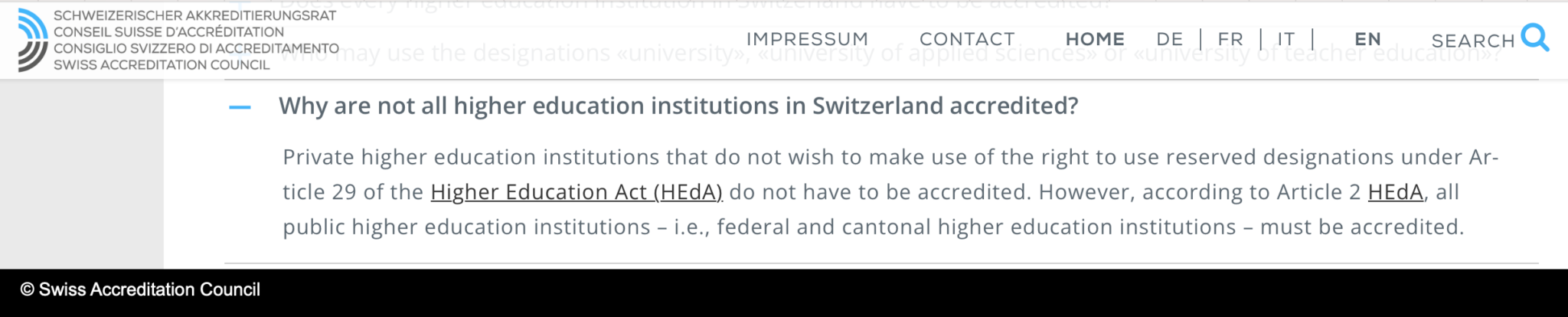
The accreditation system for Switzerland’s higher education sector (tertiary level according to the ISCED-97 classification) is regulated under the Federal Act on Funding and Coordination of the Higher Education Sector (HEdA, SR 414.20), which came into effect on January 1, 2015. According to this regulation:

  • With HEdA, designations such as "university," "university of applied sciences," "university of teacher education," and derived designations such as "university college" or "UAS college" can only be used by public or private institutions that have been institutionally accredited by the Swiss Accreditation Council. This regulation also applies to designations in languages other than Switzerland’s national languages.
  • Other designations such as “academy”, “school”, “institute”, etc. remain unreserved and do not require accreditation.
  • In case where institutions do not fall within the scope of HEdA, it is up to the cantons to prepare corresponding guidelines and establish additional rules and recognition procedures for these institutions.

References:
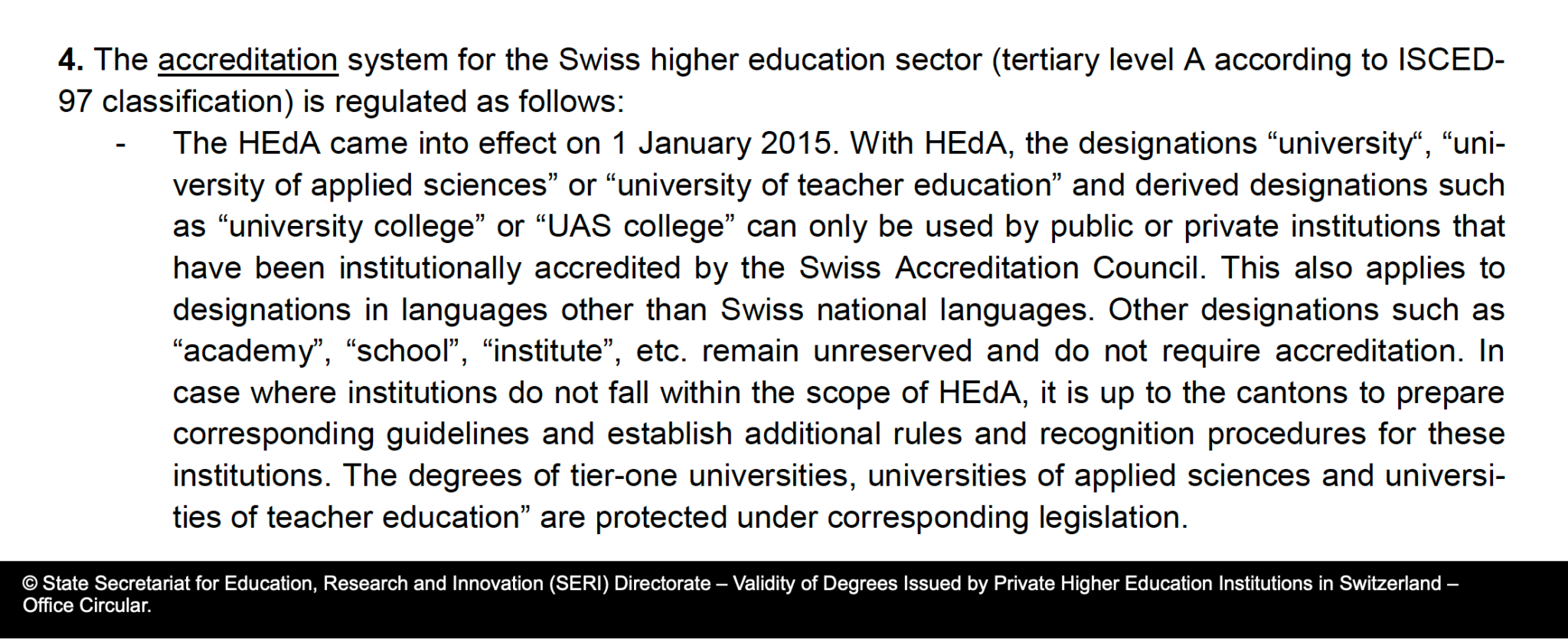
Question: Does every higher education institution in Switzerland have to be accredited?

In Switzerland, a higher education institution must be accredited in accordance with the Higher Education Act (HEdA) (Article 29) if it wishes to use a protected name such as «university», «university of applied sciences» or «university of teacher education» in a national language or in another language. This also applies to versions derived from it, such as «tier-one colleges» or «UAS colleges». On the other hand, terms such as «higher education institute», «business school» or similar are not protected by federal law. On the other hand, it may be that cantonal law is more restrictive than federal law. In this case, the canton where the respective university is located can provide you with further information.

Source: Swiss Accreditation Council; excerpt from the FAQ section [See more]
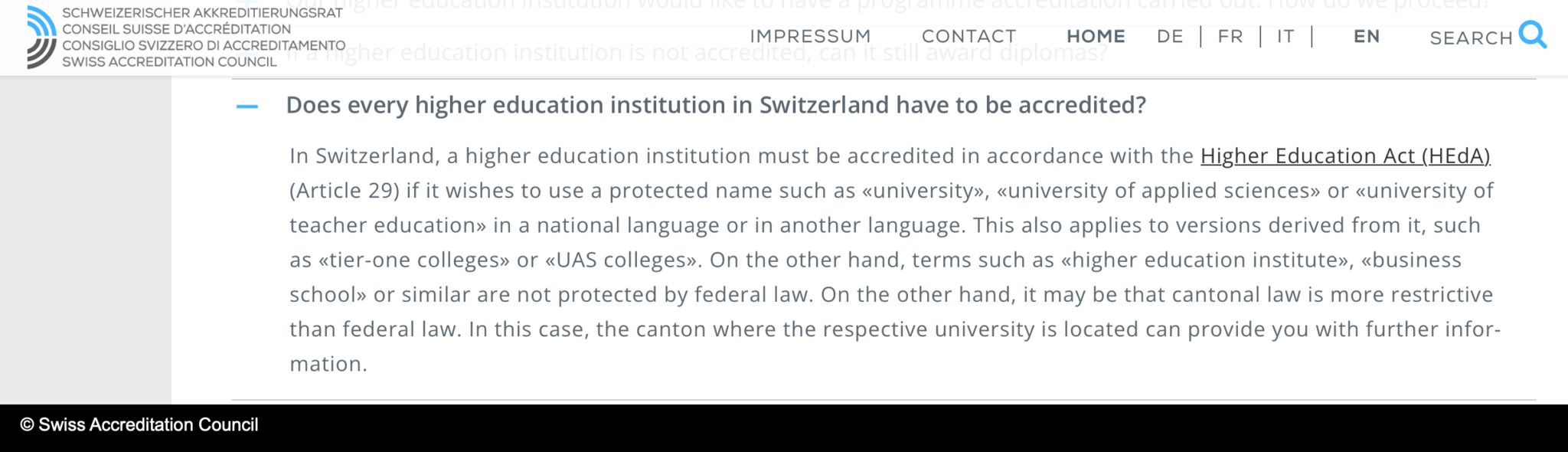
    

Question: Why are not all higher education institutions in Switzerland accredited?

Private higher education institutions that do not wish to make use of the right to use reserved designations under Article 29 of the Higher Education Act (HEdA) do not have to be accredited. However, according to Article 2 HEdA, all public higher education institutions – i.e., federal and cantonal higher education institutions – must be accredited.

Source: Swiss Accreditation Council; excerpt from the FAQ section [See more]
Question: What is the value of institutional accreditation for higher education graduates in terms of acceptance in the professional world and admission to other higher education institutions at national and international level?

Accreditation is not directly related to the acceptance of graduates in the world of work. However, accreditation plays a greater role in admission to other national and international higher education institutions.

Source: Swiss Accreditation Council; excerpt from the FAQ section [See more]

Question: I want to study at an institution that is not institutionally accredited – should I assume that it is of poor quality?

No, this conclusion cannot be drawn in this way.

Source: Swiss Accreditation Council; excerpt from the FAQ section [See more]

Principles of Qualification Recognition by the Swiss Government

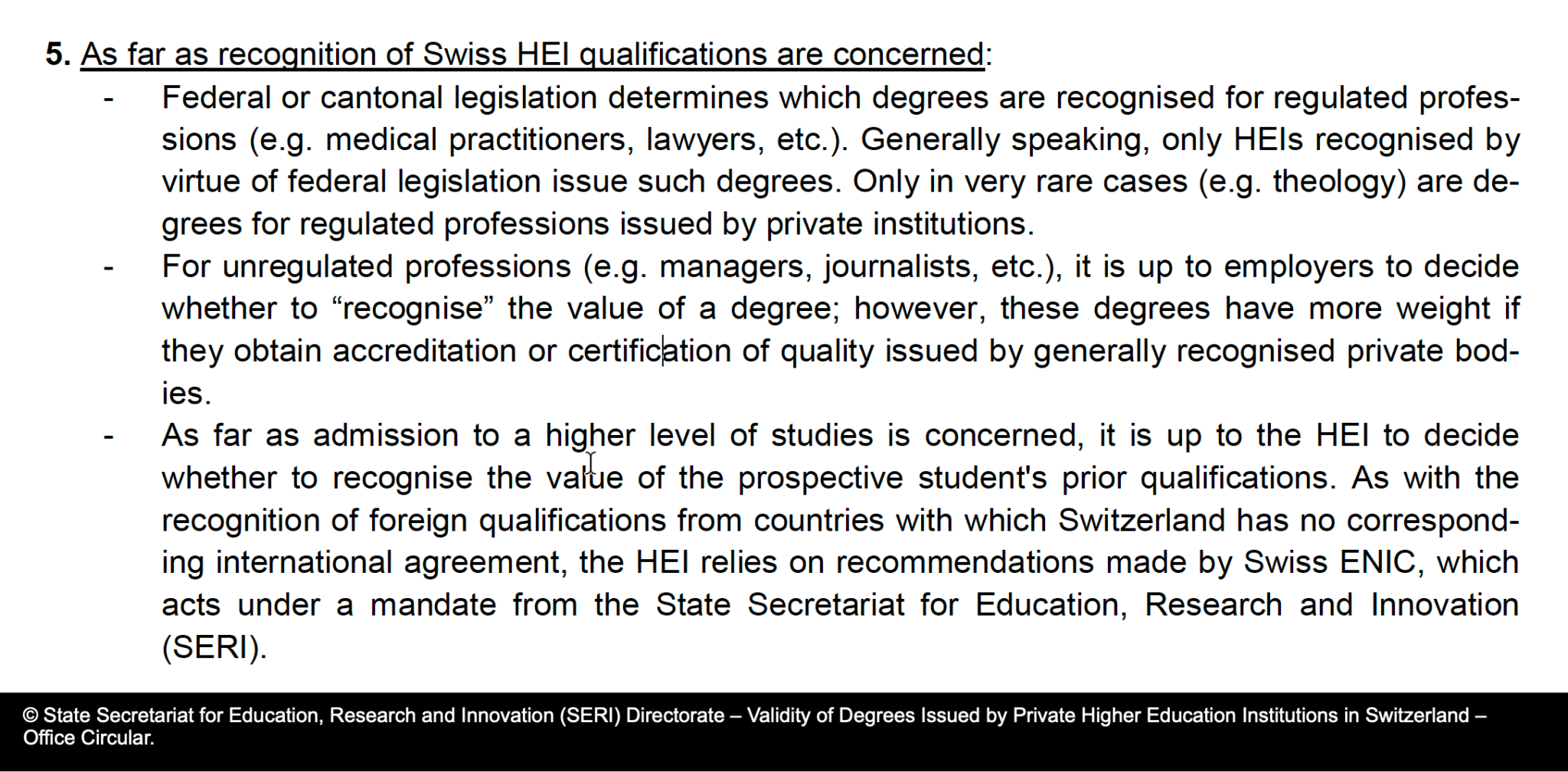
As far as recognition of Swiss HEI qualifications are concerned:
  • Federal or cantonal legislation determines which degrees are recognised for regulated professions (e.g. medical practitioners, lawyers, etc.). Generally speaking, only HEIs recognised by virtue of federal legislation issue such degrees. Only in very rare cases (e.g. theology) are degrees for regulated professions issued by private institutions.
  • For unregulated professions (e.g. managers, journalists, etc.), it is up to employers to decide whether to “recognise” the value of a degree; however, these degrees have more weight if they obtain accreditation or certification of quality issued by generally recognised private bodies.
  • As far as admission to a higher level of studies is concerned, it is up to the HEI to decide whether to recognise the value of the prospective student's prior qualifications. As with the recognition of foreign qualifications from countries with which Switzerland has no corresponding international agreement, the HEI relies on recommendations made by Swiss ENIC, which acts under a mandate from the State Secretariat for Education, Research and Innovation (SERI)
References:
Validity and Recognition of Private Degrees

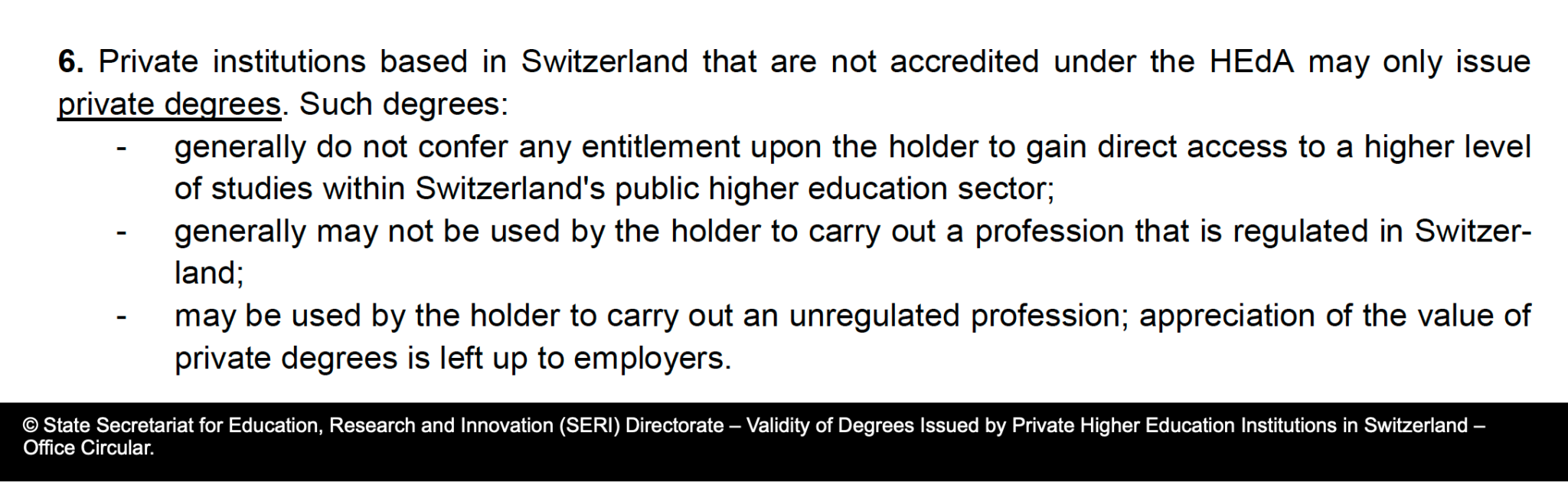
Private institutions based in Switzerland that are not accredited under the HEdA may only issue private degrees. Such degrees:

  • generally do not confer any entitlement upon the holder to gain direct access to a higher level of studies within Switzerland's public higher education sector; (Regarding admission to higher education levels, higher education institutions have full authority to decide on the recognition of the value of an applicant's previous qualifications).
  • generally may not be used by the holder to carry out a profession that is regulated in Switzerland. For this group of disciplines, private institutions typically do not offer training or issue degrees; (SIMI, as a private higher education institution in Switzerland, does not offer programs in this category.)
  • may be used by the holder to carry out an unregulated profession; appreciation of the value of private degrees is left up to employers.
References:
How to Identify and Differentiate Between Regulated and Non-Regulated Professions in Switzerland?

In Switzerland, professions can be broadly classified into regulated and non-regulated professions. Understanding the difference between these two groups is crucial for both Swiss citizens and international professionals intending to work in Switzerland.

Regulated Professions (Require Licensing & Certification)
Definition:

Regulated professions are those that require specific degrees and certifications as mandated by law to practice. These professions are typically supervised by professional bodies or government authorities.

Examples:
  • Healthcare: Doctors, nurses, pharmacists, and other medical professionals must meet strict educational and certification requirements.
    Law: Lawyers and notaries must be recognized by the bar association and meet specific education criteria.
  • Engineering & Architecture: Some engineering and architectural fields require certification from recognized professional bodies.
  • Finance: Certain financial roles, such as auditors and accountants, may require certification from accredited institutions.
Requirements:
  • Degree: A specific academic qualification, vocational training, and, in some cases, additional exams.
  • Certification: Registration with a professional body and compliance with continuous professional development requirements.
  • License: An official practice license, often requiring periodic renewal.
Non-Regulated Professions (No Licensing Required)
Definition:

Non-regulated professions do not require specific legal recognition or a professional license to practice.

Examples:
  • Management: Roles such as CEOs, HR Directors, and Business Managers.
  • Journalism: Reporters and media professionals.
  • Information Technology: Software developers, IT consultants, and network administrators.
  • Marketing & Sales: Marketing specialists, sales representatives, and business development experts.
  • Creative Industries: Graphic designers, artists, writers, and media professionals.
  • Hospitality & Tourism: Hotel managers, tour operators, and restaurant managers.
Requirements:
  • Degree & Certification: While not legally required, relevant degrees and professional certifications can improve job prospects.
  • Experience: Practical experience and a strong portfolio are often valued by employers.
  • Skills: Industry-specific skills and competencies are essential for career success.
Key Differences:
Legal Requirements:
  • Regulated Professions: Require specific degrees and certifications as mandated by law.
  • Non-Regulated Professions: No legal restrictions, but degrees can enhance employment opportunities.
Supervision:
  • Regulated Professions: Overseen by professional bodies and government authorities.
  • Non-Regulated Professions: No formal supervision, but industry standards and employer preferences apply.
Mobility and Recognition:
  • Regulated Professions: Foreign degrees may require assessment and equivalency recognition.
  • Non-Regulated Professions: More flexibility, as degrees and experience are often transferable.

SIMI Swiss Programs for Non-Regulated Professions

  • SIMI Swiss is a private higher education institution located in Zug, Switzerland. It offers single-degree programs (degrees solely awarded by SIMI) in non-regulated professions.
  • These programs allow graduates to work in various fields, including management roles such as CEO, HR Director, and Principal (Head of an educational institution).
SIMI Swiss Programs for Regulated Professions (If Applicable)

SIMI Swiss only provides programs for regulated professions through partnerships with other universities.

Through dual-degree programs and mutual recognition agreements with partner universities, students earn a dual degree. With the second degree from the partner university, students may enhance their eligibility for regulated professions (if required).

Reference:

How to Verify Whether a Profession Requires a License or Additional Certification Before Practicing in Switzerland?

To determine whether a profession requires a license or additional certification before practicing in Switzerland, follow these steps:

1. Check with Federal Authorities

  • Visit the website of the State Secretariat for Education, Research, and Innovation (SERI), which provides information on the recognition of foreign qualifications and regulated professions in Switzerland.
  • Website: SERI Official Site

2. Identify Whether the Profession is Regulated

  • Regulated professions require specific degrees or licenses to practice, such as those in healthcare, law, specialized teaching (early childhood, special education), or engineering.
  • Non-regulated professions may not require formal recognition but can be subject to industry-specific standards.

3. Consult the Professional Registers

Certain professions have specialized regulatory bodies or professional registers in Switzerland. Examples include:

  • Doctors: Swiss Medical Association (FMH)
  • Architects: REG A and REG B Registers
  • Teachers: Swiss Conference of Cantonal Ministers of Education (EDK)

4. Contact Cantonal Authorities

  • Licensing requirements may vary by canton in Switzerland. Contact the relevant cantonal office to confirm specific requirements for your profession.

5. Consider International Degree Recognition

  • If you have a foreign degree, check whether it is recognized in Switzerland. SERI provides detailed guidance on the recognition process and required steps.

6. Seek Professional Advice

  • For complex cases, consider consulting a lawyer or career advisor specializing in Swiss labor law and professional licensing.

This video offers a better understanding of professions and industries requiring additional licensing to work in Switzerland [HERE]

Accreditation, Legal Status & the SwissUK™ Advantage

Swiss Legal Foundation

A verifiable Swiss institutional base for the SwissUK™ Higher Education model.

SIMI Swiss operates through Swiss Information and Management Institute GmbH, a private limited-liability company registered in Baar, Canton of Zug, Switzerland. This Swiss legal foundation provides learners with a clearly identifiable institution, jurisdiction and centre of governance. The legal entity may be verified through the Swiss Central Business Name Index using its registered name or UID (Federal Office of Justice, n.d.).

Institutional governance, academic oversight, quality assurance and central coordination are anchored in Switzerland. SIMI Swiss conducts its activities within the applicable Swiss federal and cantonal legal framework for private education providers.

Under the Swiss Higher Education Act (HEdA), institutional accreditation is mandatory for institutions wishing to use federally protected designations such as “university,” “university of applied sciences” or “university of teacher education,” including protected compound or derived forms. Other institutional designations remain subject to the law of the canton in which the institution is established (State Secretariat for Education, Research and Innovation [SERI], n.d.).

SIMI Swiss is not currently institutionally accredited under HEdA and does not claim the protected institutional designations reserved under that Act. Its use of the designation “Higher Education Institute” reflects its institutional activities and does not represent a claim of Swiss federal institutional accreditation.

This distinction does not mean that an institution outside the HEdA-accredited framework is automatically unlawful or unable to issue qualifications. The Swiss Accreditation Council explains that private institutions not seeking to use protected designations are not necessarily required to obtain institutional accreditation. It also confirms that the right to award titles is not automatically tied to institutional accreditation, although the laws of the canton where the institution is established must be observed (Swiss Accreditation Council, 2022).

What this means for learners

The Swiss legal foundation of SIMI Swiss gives learners:

  1. A clearly identifiable Swiss legal entity and jurisdiction;
  2. Swiss-based institutional governance and academic oversight;
  3. Transparent distinction between private institutional status and federal accreditation;
  4. Programme and qualification information that can be evaluated according to its specific legal and academic framework.
How SwissUK™ complements this legal foundation

SwissUK™ Higher Education was developed to complement SIMI Swiss’s Swiss institutional foundation with selected qualifications awarded by Ofqual-recognised UK awarding organisations.

SwissUK™ does not alter the legal status of SIMI Swiss, convert a private Swiss qualification into a federally accredited Swiss degree, or present SIMI Swiss as a UK awarding organisation. Instead, it connects two clearly differentiated dimensions:

  1. The Swiss dimension: institutional governance, academic delivery and the applicable SIMI Swiss qualification;
  2. The UK dimension: a separately awarded and regulated qualification from the relevant Ofqual-recognised awarding organisation.

This structure gives eligible learners a more transparent qualification profile. The Swiss institutional component and the UK-regulated component retain their respective origins, awarding authorities and quality frameworks rather than being presented as one undifferentiated form of recognition.

Ofqual maintains public registers through which learners may verify whether an awarding organisation is officially recognised and whether a qualification is regulated. This adds a separately verifiable qualification layer to the SwissUK™ model (Office of Qualifications and Examinations Regulation [Ofqual], n.d.).

Learner advantage

SwissUK™ combines a transparent Swiss institutional foundation with a separately regulated UK qualification pathway—giving learners clearer evidence of where each qualification comes from, who awards it and which quality framework applies.

Important clarification

Institutional registration, external accreditation, approved-centre status and qualification regulation are distinct legal and quality concepts. None should be interpreted as automatic recognition in every country, profession, university or employment context.

References

Accreditation & Quality Assurance

Multiple quality-assurance layers supporting the SwissUK™ Higher Education model.

SIMI Swiss voluntarily applies a multi-layered quality-assurance framework that includes independent external accreditation, programme and management-system review, educational management-system certification, Swiss professional membership, and approved-centre relationships with Ofqual-recognised UK awarding organisations (SIMI Swiss QAQC, n.d.).

These statuses perform different functions. They should therefore be understood separately rather than presented as equivalent forms of governmental or federal accreditation.

Independent Institutional Accreditation

SIMI Swiss holds international institutional accreditation from the Accreditation Service for International Schools, Colleges and Universities (ASIC) within the scope and validity stated in its current accreditation record.

ASIC’s international accreditation process examines areas such as governance, management, teaching and learning, quality assurance, learner welfare, resources, awards and institutional operations. ASIC describes its accreditation as independent external quality assurance intended to identify good practice and support continuing institutional improvement (Accreditation Service for International Schools, Colleges and Universities [ASIC], 2023).

For learners, this provides an additional external review of the institutional environment in which programmes are governed and supported.

ASIC accreditation does not itself grant degree-awarding authority or constitute Swiss federal institutional accreditation. Its role is to provide independent evaluation and quality benchmarking within its stated scope (ASIC, 2023).

Educational Management-System Certification

SIMI Swiss has presented certification against ISO 21001:2018, the international management-system standard developed specifically for educational organisations.

ISO 21001 focuses on how an educational organisation establishes, manages, evaluates and continually improves systems intended to meet learner and stakeholder needs. Certification concerns the organisation’s management system within the scope stated on the certificate; it is not institutional or programme accreditation under Swiss higher education law (International Organization for Standardization [ISO], 2018).

For learners, this quality layer supports more systematic processes for programme management, learner services, evaluation, feedback and continuous improvement.

ISO published ISO 21001:2025 as the second edition of the standard. SIMI Swiss should continue to state the version and validity exactly as shown on its current certificate and announce migration to the newer edition only after the relevant certification process has been formally completed (ISO, 2025).

Swiss Professional Membership

SIMI Swiss is a member of the Swiss Federation for Adult Learning (SVEB).

SVEB is Switzerland’s national umbrella organisation and professional association for adult and continuing education. Its network brings together public and private education providers, associations, corporate training departments and individual professionals (Swiss Federation for Adult Learning [SVEB], n.d.).

For learners, SVEB membership connects SIMI Swiss with professional developments, networks and quality discussions within the Swiss continuing-education environment.

SVEB membership is a professional institutional affiliation. It does not constitute Swiss federal accreditation, government recognition of every programme or approval of every qualification offered by a member institution.

UK-Regulated Qualification Quality Assurance

Selected SwissUK™ pathways include qualifications awarded by Ofqual-recognised UK awarding organisations, including approved relationships with organisations identified for the relevant programme.

Ofqual regulates qualifications, examinations and assessments in England. Its public registers allow learners to verify whether an awarding organisation is officially recognised, which qualification types it is permitted to offer, and whether a specific qualification is regulated (Office of Qualifications and Examinations Regulation [Ofqual], n.d.-a, n.d.-b).

Approved-centre status allows a centre to deliver only the qualifications and arrangements formally approved by the relevant awarding organisation. The centre remains subject to the awarding organisation’s requirements for learner registration, assessment, internal quality assurance, external verification, monitoring and compliance.

For learners, this adds a separately regulated qualification layer with publicly identifiable:

  1. Awarding organisation;
  2. Qualification title and number;
  3. Regulated qualification level;
  4. Credit value and learning outcomes;
  5. Assessment and quality-assurance requirements.

Ofqual recognition applies to the awarding organisation and the specific regulated qualification. It does not mean that SIMI Swiss itself is accredited by the UK Government or authorised to issue UK-regulated qualifications independently (Ofqual, 2026).

How These Quality Layers Strengthen SwissUK™

SwissUK™ was developed to connect two complementary but legally distinct quality dimensions.

The Swiss dimension is supported by SIMI Swiss’s Swiss-based governance, academic oversight, internal quality assurance, independent accreditation, external review and educational management systems.

The UK dimension is supported by the relevant Ofqual-recognised awarding organisation, regulated qualification specifications, approved-centre controls and external quality-assurance processes.

This structure helps avoid the common mistake of treating institutional accreditation and qualification recognition as the same concept. Instead, SwissUK™ gives learners a clearer understanding of:

  1. Who governs and delivers the academic pathway;
  2. Which external bodies review institutional quality;
  3. Who awards each qualification;
  4. Which qualification is regulated;
  5. Which quality framework applies to each component.
Learner advantage

SwissUK™ combines externally reviewed Swiss academic delivery with separately regulated UK qualification pathways, providing learners with a more transparent and multi-layered quality structure.

Important clarification

International accreditation, programme review, ISO certification, professional membership, approved-centre status and regulated qualification status are distinct.

They strengthen quality assurance and transparency within their respective scopes, but none should be interpreted as Swiss federal institutional accreditation or as guaranteed acceptance of a qualification by every university, employer, professional body or public authority.

References

Why SwissUK™ Integrates Swiss & UK Qualifications

Connecting Swiss academic achievement with a separately regulated and publicly verifiable UK qualification pathway.

SIMI Swiss developed SwissUK™ Higher Education to connect two complementary but legally distinct dimensions within one academically structured pathway.

The model brings together:

  1. A Swiss institutional and academic dimension, coordinated through SIMI Swiss; and
  2. A UK-regulated qualification dimension, awarded separately by an Ofqual-recognised awarding organisation where included in the programme.

SwissUK™ does not merge the Swiss and UK systems into a new governmental recognition category. Each qualification retains its own origin, awarding authority, legal status and quality framework.

This distinction enables learners to understand not only what they have achieved, but also who awards each qualification, which framework applies and how each award may be independently verified.

The Swiss Institutional and Academic Dimension

The Swiss dimension of SwissUK™ is anchored in SIMI Swiss’s legal establishment, institutional governance, academic oversight and quality coordination in Switzerland.

Depending on the programme, this dimension may include a SIMI Swiss institutional qualification reflecting:

  • The complete academic pathway;
  • Programme learning outcomes;
  • Applied and competency-based learning;
  • Academic assessment and institutional requirements;
  • The learner’s achievement within the SIMI Swiss academic environment.

Swiss law distinguishes between institutions using designations protected under the Swiss Higher Education Act and institutions operating under other designations subject to applicable cantonal law. Institutional accreditation under HEdA is mandatory for institutions seeking to use protected designations such as “university” and “university of applied sciences,” including protected derived forms (State Secretariat for Education, Research and Innovation [SERI], n.d.-a).

The protection and status of qualification titles in Switzerland depend on the legal basis applying to the institution and qualification concerned. Title protection is not governed through one uniform national system for every type of Swiss qualification (SERI, n.d.-b).

For this reason, the Swiss component of SwissUK™ is described according to SIMI Swiss’s actual private institutional position rather than through a general claim that every Swiss qualification has federal recognition.

Learner benefit

Learners receive a qualification reflecting the broader academic pathway, with a clearly identifiable Swiss institution responsible for academic governance and institutional requirements.

The UK-Regulated Qualification Dimension

Selected SwissUK™ programmes include a separate qualification awarded by an Ofqual-recognised UK awarding organisation.

Ofqual regulates qualifications, examinations and assessments in England. Its official register allows learners and receiving organisations to verify whether an awarding organisation is recognised and whether a particular qualification is regulated (Office of Qualifications and Examinations Regulation [Ofqual], n.d.-a, n.d.-b).

Ofqual recognition applies within an awarding organisation’s defined scope of recognition. This scope identifies the qualification types, levels and subject areas that the organisation is permitted to offer as regulated qualifications. Recognition of an awarding organisation does not necessarily mean that every qualification it offers is regulated (Ofqual, 2025a; Ofqual, 2026).

For each regulated qualification, the responsible awarding organisation must address matters such as:

  • The qualification’s objective;
  • Its official title and specification;
  • Assessment fitness and delivery;
  • Total Qualification Time;
  • Credit, where applicable;
  • Qualification level;
  • Submission of the qualification to the official register.

These requirements are established through Ofqual’s General Conditions of Recognition (Ofqual, 2025b).

Learner benefit

Learners gain a separately awarded qualification whose awarding organisation, title, level and regulatory status may be checked through an official public source.

Why the Two Dimensions Are Integrated

SIMI Swiss developed SwissUK™ because a full academic pathway and a regulated qualification can demonstrate different but complementary dimensions of learner achievement.

The Swiss dimension may demonstrate
  • Completion of the broader academic programme;
  • Applied higher education outcomes;
  • Integrated academic and professional learning;
  • Achievement of SIMI Swiss institutional requirements;
  • Participation in a Swiss-governed academic environment.
The UK dimension may demonstrate
  • Achievement against a published qualification specification;
  • Competencies assessed at a stated regulated level;
  • Compliance with the awarding organisation’s assessment requirements;
  • A qualification recorded within the UK regulated system;
  • Separately verifiable qualification information.

By connecting these dimensions, SwissUK™ enables eligible learners to present a more complete qualification profile:

The Swiss component reflects the academic pathway; the UK component provides a separately regulated record of defined learning and competencies.

The qualifications remain distinct. They are academically connected but are not represented as legally identical.

How SwissUK™ Supports Legal Transparency

SwissUK™ does not make SIMI Swiss federally accredited under Swiss law, and it does not make SIMI Swiss an Ofqual-recognised awarding organisation.

Instead, the model clearly separates five elements:

  1. SIMI Swiss as the Swiss institution responsible for its assigned academic and institutional functions;
  2. The applicable SIMI Swiss qualification;
  3. The UK awarding organisation responsible for the regulated qualification;
  4. The exact UK qualification awarded;
  5. The legal and quality framework applying to each component.

This distinction is important because the following concepts are not interchangeable:

  • Swiss legal establishment;
  • Swiss federal institutional accreditation;
  • Independent external accreditation;
  • UK approved-centre status;
  • Ofqual recognition of an awarding organisation;
  • Regulation of a specific qualification.

SwissUK™ complements SIMI Swiss’s Swiss legal foundation by adding a separate, externally regulated qualification layer. It does not use that UK layer to redefine or overstate SIMI Swiss’s legal status in Switzerland.

Learner benefit

Learners receive a structure that is easier to explain and verify because each institution and qualification is presented according to its actual role and status.

The SwissUK™ Qualification Advantage

For eligible learners in an applicable programme, SwissUK™ may provide the following advantages.

1. A Complementary Swiss and UK Profile

Learners may receive evidence of achievement from both a Swiss institutional academic pathway and a separately regulated UK qualification structure.

2. Evidence of Academic and Professional Competencies

The qualification combination may present broader academic achievement alongside clearly specified and assessed competencies.

3. Independent UK Verification

The relevant UK awarding organisation and regulated qualification may be checked through Ofqual’s public registers (Ofqual, n.d.-a, n.d.-b).

4. Clearer International Presentation

Learners can explain separately:

  • Where the academic pathway was governed;
  • Who delivered or coordinated the programme;
  • Who issued each qualification;
  • Which status and framework apply to each award.
5. Additional Information for Academic Progression

A regulated UK qualification can provide receiving institutions with structured information concerning level, objectives, size and learning outcomes.

Qualification level indicates the relative difficulty of a qualification, but qualifications at the same level may differ substantially in their type, content and volume of learning. A Level 7 diploma, for example, is not automatically the same award as a master’s degree merely because both appear at Level 7 (UK Government, n.d.).

6. Broader Evidence for Employment and Professional Development

Learners may present the complete qualification profile, transcript and regulated qualification information according to the requirements of the employer or professional context.

7. Clearer Allocation of Responsibility

SwissUK™ identifies which organisation is responsible for academic delivery, assessment, quality assurance and qualification issuance.

Programme-Specific Qualification Disclosure

SwissUK™ does not require every SIMI Swiss programme to offer the same qualification combination.

Each official programme page should identify:

  1. The exact SIMI Swiss qualification, where applicable;
  2. The exact UK-regulated qualification, where applicable;
  3. The awarding institution or organisation for each qualification;
  4. The UK qualification number;
  5. The applicable level, size and credit value;
  6. The assessment and quality-assurance requirements;
  7. The eligibility conditions for receiving each qualification;
  8. Any additional registration or awarding fees;
  9. The principal progression and recognition limitations.

The terms dual qualification, integrated qualification or Swiss–UK qualification profile should be used only where the programme formally includes the qualifications concerned.

Learners should not assume that enrolment in one component automatically guarantees receipt of every associated award. Each qualification remains subject to its own academic, assessment, registration and quality-assurance requirements.

What SwissUK™ Means for Learners

SwissUK™ gives learners access to an academically connected structure without concealing the differences between its components.

Learners can identify:

  • The legal and institutional foundation of SIMI Swiss;
  • The role performed by SIMI Swiss;
  • The status of the Swiss institutional qualification;
  • The identity of the UK awarding organisation;
  • The regulatory status of the UK qualification;
  • The requirements for completing each component;
  • The verification sources available to third parties.

This clarity supports informed decision-making and makes it easier for receiving institutions, employers and evaluators to understand the learner’s qualification profile.

Learner Advantage

SwissUK™ combines Swiss academic achievement with a separately awarded, regulated and publicly verifiable UK qualification—giving eligible learners a clearer and more complete qualification profile.

Important Clarification

SwissUK™ is an institutional and academic model developed by SIMI Swiss. It is not:

  • A Swiss or UK governmental accreditation category;
  • A national qualifications framework;
  • Automatic equivalence between Swiss and UK qualifications;
  • Automatic academic or professional recognition;
  • A guarantee of admission, credit transfer, employment or professional licensing.

A UK qualification at the same level as a university award is not necessarily the same qualification type or size. Academic progression, credit recognition and third-party acceptance remain subject to the requirements and independent decisions of the receiving institution, employer, evaluator, professional body or competent authority.

References

Swiss–UK Recognition Context

A bilateral framework supporting clearer professional-recognition pathways between Switzerland and the United Kingdom.

The Agreement between the United Kingdom of Great Britain and Northern Ireland and the Swiss Confederation on Recognition of Professional Qualifications was signed on 14 June 2023 and entered into force on 8 March 2025 (Foreign, Commonwealth & Development Office [FCDO], 2025).

The Agreement reflects closer cooperation between Switzerland and the United Kingdom and establishes a formal framework for professionals seeking recognition of qualifications in order to access or practise a regulated profession in the other country. The Swiss Federal Council has described the Agreement as supporting access to regulated professional activities and strengthening professional mobility between the two countries (Federal Council, 2024).

What the Agreement Covers

The Agreement applies when:

  1. A professional has obtained professional qualifications in Switzerland and seeks access to a regulated profession in the United Kingdom; or
  2. A professional has obtained professional qualifications in the United Kingdom and seeks access to a regulated profession in Switzerland.

A regulated profession is one for which the law requires a person to hold specific professional qualifications in order to practise the profession or use the corresponding professional title.

The relevant authority in the receiving country remains responsible for determining whether the applicant’s professional qualifications are comparable and whether all other professional requirements have been satisfied (Department for Business and Trade [DBT], 2025a).

Key Advantages for Eligible Professionals
1. A Defined Bilateral Recognition Route

Professionals are provided with an established route through which qualifications obtained in one country may be submitted for recognition in the other.

This offers greater procedural clarity than relying solely on informal or case-by-case enquiries, although the competent authority continues to assess every application individually (DBT, 2025a).

2. Assessment Based on Comparable Qualifications

Where access to a regulated profession depends on specific professional qualifications, the relevant authority must assess whether the applicant holds qualifications comparable to those required in the receiving country.

Comparability is determined according to the knowledge, skills, professional activities and requirements of the particular profession. It does not mean that qualifications are automatically treated as identical (DBT, 2025a).

3. Bridging Measures Where Differences Remain

Where substantial differences exist between the applicant’s qualifications and the requirements of the regulated profession, the competent authority may require a proportionate compensatory measure.

This may take the form of:

  • An aptitude test;
  • A supervised adaptation period; or
  • Another applicable profession-specific requirement.

These measures can provide a pathway to address identified differences rather than requiring immediate rejection of the application. Where possible, applicants may request written reasons for the compensatory measures imposed (FCDO, 2025).

4. Clearer Application Timelines

The Agreement establishes procedural timeframes intended to make the recognition process more predictable.

The relevant authority must:

  1. Acknowledge receipt of an application within one month;
  2. Inform the applicant of missing documentation;
  3. Allow adequate time to complete the application; and
  4. Issue a decision no later than four months after receiving a complete application.

Evidence requests must be limited to what is reasonably necessary to assess the professional qualification and other applicable conditions (FCDO, 2025).

5. Access to Relevant Recognition Information

Competent authorities must make relevant information available to applicants, including information concerning:

  • Qualifications required to practise the profession;
  • Licensing and professional-registration conditions;
  • Professional-body membership;
  • Language requirements;
  • Good-character requirements;
  • Professional indemnity insurance;
  • Documentation and application procedures;
  • Professional conduct and supervisory requirements.

This helps applicants understand the complete professional pathway rather than considering the qualification in isolation (FCDO, 2025).

6. Appeal Rights and Transparent Fees

The Agreement requires each country to maintain measures granting applicants a right of appeal where:

  • Access to a regulated profession is refused; or
  • The competent authority fails to make a recognition decision.

Application fees must be reasonable, proportionate to the cost of processing the application, transparent and published in advance (FCDO, 2025).

7. Opportunities for Future Profession-Specific Arrangements

Switzerland and the United Kingdom may develop additional arrangements for particular professions.

These arrangements may provide:

  • Streamlined procedures;
  • Profession-specific administrative processes;
  • Standard compensatory measures;
  • Facilitated or expedited recognition routes.

The availability of any such arrangement depends on the specific profession and future agreements between the relevant authorities (FCDO, 2025).

How This Context Relates to SwissUK™

SwissUK™ Higher Education is positioned within a wider environment of increasing educational and professional cooperation between Switzerland and the United Kingdom.

Selected SwissUK™ pathways may provide eligible learners with:

  1. A qualification reflecting the Swiss institutional and academic dimension of SIMI Swiss; and
  2. A separately awarded qualification from an Ofqual-recognised UK awarding organisation.

This complementary structure can help learners present clearly organised evidence associated with both qualification environments, including:

  • The origin of each qualification;
  • The responsible awarding institution or organisation;
  • The relevant level and learning outcomes;
  • The applicable assessment and quality-assurance arrangements;
  • Evidence of academic and professionally relevant competencies.

For learners pursuing international academic or professional opportunities, this transparency may make their qualification profile easier for universities, employers, evaluators and professional authorities to understand.

What SwissUK™ Does Not Claim

The Swiss–UK Agreement does not directly accredit, endorse or recognise:

  • SIMI Swiss as an institution;
  • SwissUK™ as an education model;
  • Every SIMI Swiss qualification;
  • Every UK-regulated qualification;
  • Every qualification combination offered through SwissUK™.

Holding both Swiss and UK qualifications does not automatically provide entitlement under the Agreement.

An applicant must still demonstrate that:

  1. The intended profession is regulated in the receiving jurisdiction;
  2. The submitted professional qualification falls within the applicable recognition framework;
  3. The qualification is considered comparable by the relevant authority; and
  4. All other licensing, language, conduct, experience or registration conditions are satisfied.

The Agreement regulates the recognition of professional qualifications. It does not itself provide a right to employment, immigration status, labour-market access or automatic academic equivalence (FCDO, 2025).

Learner Advantage

SwissUK™ provides a transparent Swiss and UK qualification profile within a wider bilateral environment that supports clearer professional-recognition pathways between the two countries.

Important Recognition Notice

The relevance of the Agreement depends on the learner’s specific qualification, profession and intended jurisdiction.

Recognition is not automatic and remains subject to the assessment and independent decision of the competent professional authority. Learners intending to enter a regulated profession should verify the applicable requirements directly with that authority before enrolment or before relying on a qualification for professional practice.

References

Why External Quality Matters

Voluntary external assurance strengthens learner confidence, institutional accountability and the SwissUK™ Higher Education model.

SIMI Swiss distinguishes between legal status, institutional quality assurance and qualification regulation.

Its Swiss legal establishment provides the institutional foundation for its activities. Independent accreditation and certification provide external review of governance, academic systems and learner support. Selected UK-regulated qualification pathways add a separate layer of qualification-level oversight through Ofqual-recognised awarding organisations.

These layers do not replace one another. Together, they provide learners with a clearer and more transparent education structure.

External Quality Assurance Is a Voluntary Institutional Commitment

Under the Swiss Higher Education Act (HEdA), institutional accreditation is mandatory for institutions wishing to use federally protected designations such as “university,” “university of applied sciences” or “university of teacher education.” Not every private education institution is required at federal level to obtain HEdA accreditation when it does not use those protected designations, although additional cantonal requirements may apply (State Secretariat for Education, Research and Innovation [SERI], n.d.; Swiss Accreditation Council, 2022).

Within this legal context, SIMI Swiss voluntarily pursues external accreditation, certification and professional quality engagement as additional evidence of its commitment to academic quality.

This distinction is important:

Legal establishment defines the institutional foundation; external quality assurance independently examines how the institution operates and improves.

External accreditation does not make SIMI Swiss “more legally established,” nor does it replace Swiss federal institutional accreditation. Its value lies in adding structured, independent review to the existing Swiss legal foundation.

1. Independent Review of Institutional Operations

External quality assurance enables an organisation outside SIMI Swiss to examine important areas of institutional operation.

Depending on the scope of the relevant accreditation or certification, this may include:

  • Governance and institutional management;
  • Academic oversight;
  • Quality assurance and quality enhancement;
  • Teaching, learning and research activities;
  • Awards and qualification administration;
  • Learner welfare and support;
  • Systems management;
  • Ethical marketing and recruitment.

ASIC’s international accreditation framework, for example, evaluates institutions across eight operational areas and uses external review to recognise good practice while identifying opportunities for further development (Accreditation Service for International Schools, Colleges and Universities [ASIC], n.d.-a).

Learner benefit

Learners gain additional assurance that institutional systems are not evaluated only through internal statements, but are also considered against external standards and review processes.

2. Continuous Improvement Rather Than One-Time Compliance

Meaningful quality assurance should not end when an accreditation or certificate is issued.

External review can provide:

  1. Independent observations on existing strengths;
  2. Recommendations for institutional improvement;
  3. Periodic monitoring or re-evaluation;
  4. Evidence to support management decisions;
  5. Benchmarks for future development.

ASIC describes its international accreditation as a process intended to recognise effective practice and provide recommendations supporting continuous institutional development (ASIC, n.d.-a, n.d.-b).

For SIMI Swiss, external findings may contribute to the ongoing improvement of academic procedures, learner services, quality controls and institutional governance.

Learner benefit

Learners study within a system intended to learn from evidence, review its performance and progressively improve the educational experience.

3. More Systematic Learner-Centred Management

Educational management-system standards encourage institutions to establish documented processes for planning, delivery, evaluation and improvement.

ISO 21001 is specifically designed for organisations that provide educational products and services. It establishes requirements and guidance for an educational organisation management system (International Organization for Standardization [ISO], 2025).

Within its certified scope, an educational management system can support more consistent approaches to:

  • Learner needs and expectations;
  • Programme administration;
  • Communication and learner support;
  • Feedback and complaints;
  • Monitoring and evaluation;
  • Corrective action and continuous improvement.

ISO certification concerns the management system described in the applicable certificate. It does not constitute institutional or programme accreditation under HEdA.

Learner benefit

Learners benefit from clearer procedures, more consistent services and a structured mechanism through which feedback and operational evidence may inform improvement.

4. Stronger Transparency and Accountability

External quality assurance requires an institution to explain and evidence how its systems operate.

This may involve documenting:

  1. Who is responsible for academic decisions;
  2. How programmes are approved and reviewed;
  3. How learner work is assessed;
  4. How quality concerns are identified and resolved;
  5. How learners receive support;
  6. How institutional information is communicated;
  7. How improvement actions are monitored.

This supports a culture in which institutional claims should be linked to defined processes, evidence and identifiable responsibilities.

Learner benefit

Learners can more clearly understand who governs their programme, which quality systems apply and where responsibility sits when academic or administrative support is required.

5. Separately Regulated UK Qualification Controls

The UK-regulated dimension of SwissUK™ provides a different form of quality assurance.

Ofqual’s General Conditions of Recognition establish legally binding rules for recognised awarding organisations and regulated qualifications. These rules address governance, arrangements with centres, qualification design, assessment, results, appeals and certificates (Office of Qualifications and Examinations Regulation [Ofqual], 2025).

Where assessment is conducted by an approved centre, the awarding organisation remains responsible for applying appropriate centre-assessment scrutiny and ensuring that results are supported by sufficient evidence (Ofqual, 2025).

This means that the UK qualification dimension is not created merely by SIMI Swiss describing a programme as “UK-based.” It depends on:

  • A recognised awarding organisation;
  • A qualification within that organisation’s scope of recognition;
  • Approved centre arrangements;
  • Compliance with assessment and quality-assurance requirements;
  • A separate awarding decision by the responsible organisation.
Learner benefit

Learners receive a UK qualification component whose awarding organisation, regulatory status and qualification information can be independently checked through official public sources.

6. Clear Separation of Institutional and Qualification Quality

SwissUK™ was developed around the principle that institutional quality and qualification regulation should complement one another without being confused.

The model brings together:

Swiss Institutional Quality
  • Swiss-based governance and academic oversight;
  • SIMI Swiss internal quality assurance;
  • Independent institutional review;
  • Educational management-system certification;
  • Academic and learner-support processes.
UK Qualification Quality
  • An Ofqual-recognised awarding organisation;
  • A separately regulated qualification;
  • Published qualification specifications;
  • Awarding-organisation assessment requirements;
  • External controls applying to approved centres.

The inclusion of a UK-regulated qualification does not change SIMI Swiss’s Swiss legal status. Similarly, external accreditation of SIMI Swiss does not replace the regulation applicable to the UK qualification.

Learner benefit

Learners receive clearer evidence of both: the quality environment in which learning is delivered; and the regulatory framework under which the relevant UK qualification is awarded.

7. Supporting Long-Term Institutional Development

Voluntary external quality assurance also supports SIMI Swiss’s longer-term institutional development.

The process of preparing for accreditation or certification can encourage the institution to strengthen:

  • Governance documentation;
  • Academic independence and responsibility;
  • Internal quality assurance;
  • Evidence management;
  • Learner-protection mechanisms;
  • Programme monitoring;
  • Institutional sustainability.

This experience may support preparation for future Swiss institutional accreditation. However, international accreditation, ISO certification and UK approved-centre status do not constitute HEdA accreditation or guarantee admission to the Swiss accreditation procedure.

The Swiss Accreditation Council remains the competent body for decisions under the HEdA institutional accreditation framework (SERI, n.d.).

How External Quality Assurance Strengthens SwissUK™

SwissUK™ connects SIMI Swiss’s Swiss legal and institutional foundation with selected UK-regulated qualification pathways.

External quality assurance strengthens this model in three ways:

1. It supports the Swiss academic environment

Independent review and management-system certification provide additional scrutiny of governance, delivery, learner support and quality processes.

2. It supports the UK qualification pathway

The responsible Ofqual-recognised awarding organisation applies its own approval, assessment, monitoring and awarding requirements.

3. It improves transparency for learners

Learners can distinguish:

  • SIMI Swiss’s legal status in Switzerland;
  • The external quality statuses held by SIMI Swiss;
  • The SIMI Swiss qualification, where applicable;
  • The separately regulated UK qualification;
  • The organisation responsible for each award;
  • The limitations and intended use of each status.

SwissUK™ therefore does not depend on presenting different quality concepts as though they were identical. Its distinctive value lies in connecting clearly differentiated quality and qualification layers within one academic pathway.

Learner Advantage

External quality assurance strengthens SwissUK™ by combining independently reviewed Swiss academic systems with separately regulated UK qualification controls—giving learners a more transparent, accountable and verifiable study pathway.

Important Clarification

External accreditation, ISO certification, professional membership, approved-centre status and regulated qualification status apply only within their respective confirmed scopes.

They do not:

  • Replace Swiss federal institutional accreditation;
  • Convert SIMI Swiss into a federally accredited Swiss university;
  • Make SIMI Swiss a UK awarding organisation;
  • Guarantee recognition by every university, employer or authority;
  • Guarantee admission, graduation, employment or professional licensing.

Their value lies in providing additional evidence of quality, accountability and transparency for learners and other stakeholders.

References

Study Pathways & Learner Transparency

Swiss Headquarters & Academic Governance

Swiss-based governance and academic oversight for internationally delivered study pathways.

SIMI Swiss maintains its institutional headquarters at Blegistrasse 7, 6340 Baar, Canton of Zug, Switzerland. The Swiss headquarters serves as the central base for institutional governance, academic oversight, quality coordination and international programme management (SIMI Swiss, n.d.).

From Switzerland, SIMI Swiss coordinates the academic and institutional systems supporting its different study pathways. Depending on the programme, these responsibilities may include:

  1. Institutional governance and academic policy;
  2. Curriculum and programme coordination;
  3. Internal quality assurance and quality control;
  4. Academic standards and assessment oversight;
  5. Faculty, supervisor and academic-resource coordination;
  6. Learner records and institutional documentation;
  7. Cooperation with awarding organisations and partner institutions;
  8. Monitoring and continuous improvement.

This structure gives learners a clearly identifiable Swiss institutional base while allowing programmes to be delivered through digital environments or authorised partner-campus arrangements.

A Consistent Academic Framework Across Study Pathways

SIMI Swiss may support learners through different study structures, but its academic governance remains coordinated through Switzerland.

This helps maintain greater consistency in:

  • Academic policies and procedures;
  • Programme learning outcomes;
  • Quality-assurance expectations;
  • Learner-support principles;
  • Institutional documentation;
  • The allocation of roles among SIMI Swiss, awarding organisations and partner institutions.

For learners, this means that studying internationally or digitally does not remove the programme from SIMI Swiss’s central academic and quality-coordination framework.

The precise responsibilities of SIMI Swiss may nevertheless vary according to the programme. Where a partner university or external awarding organisation retains authority over admission, assessment, student status or qualification issuance, those responsibilities are identified separately in the official programme information.

How the Swiss Headquarters Supports SwissUK™

The SwissUK™ Higher Education model is anchored in the principle that institutional governance and qualification regulation should be connected without being confused.

Within this structure:

  1. SIMI Swiss provides the Swiss institutional and academic foundation;
  2. The relevant UK awarding organisation retains independent responsibility for its regulated qualification;
  3. Each programme identifies who delivers, assesses and awards each component.

The Swiss headquarters therefore supports the academic coherence of SwissUK™, while the UK-regulated qualification remains subject to the requirements and independent awarding decision of the relevant Ofqual-recognised organisation.

This separation strengthens transparency for learners because the origin, role and quality framework of each qualification can be clearly identified.

What the Swiss Headquarters Means for Learners

The Swiss headquarters provides learners with:

  1. A clearly identifiable institutional base in Switzerland;
  2. Swiss-based academic governance and quality coordination;
  3. Consistent institutional policies across international pathways;
  4. Central coordination of academic resources and programme standards;
  5. Clearer accountability for the responsibilities retained by SIMI Swiss.

The Swiss headquarters anchors the academic and institutional dimension of SwissUK™, while each awarding organisation remains responsible for its own qualification.

Study Location and Delivery Mode

The existence of a Swiss headquarters does not, by itself, mean that every SIMI Swiss programme is delivered through full-time campus study in Switzerland.

Each official programme page identifies the applicable:

  • Study mode;
  • Delivery platform or study location;
  • Responsible delivery institution;
  • Student status;
  • Assessment authority;
  • Awarding institution or organisation.

Unless a programme is expressly described as a physical study pathway in Switzerland, learners should understand it according to the online, partner-campus or other delivery structure stated in the official programme documentation.

Swiss Student Visa and Residence Status

Admission to an online or internationally delivered SIMI Swiss programme does not automatically create eligibility for a Swiss student visa, residence permit or full-time student status in Switzerland.

Official Swiss guidance states that studying in Switzerland requires confirmation of acceptance from the relevant educational institution. Depending on the learner’s nationality, a residence-permit or visa application must then be submitted to the competent Swiss authorities, which independently decide whether the requirements for entry and residence have been satisfied (Federal Department of Foreign Affairs [FDFA], n.d.).

A Swiss student visa or residence permit should therefore be expected only where:

  1. The specific programme is formally delivered in Switzerland;
  2. The learner has received the required admission or enrolment confirmation;
  3. The applicable financial, accommodation and documentation requirements are satisfied; and
  4. The competent Swiss immigration authority approves the application.

SIMI Swiss does not guarantee the approval of any visa, residence permit or immigration application.

Learner Advantage

Learners benefit from Swiss-based academic governance and quality coordination while accessing study pathways designed for digital and international participation.

Important Clarification

The Swiss headquarters represents the institutional, governance and academic-coordination base of SIMI Swiss.

It should not automatically be interpreted as:

  • Confirmation of full-time campus study in Switzerland;
  • Eligibility for a Swiss student visa or residence permit;
  • Admission to a federally accredited Swiss university programme;
  • A guarantee of an internship, employment or residence opportunity in Switzerland.

The official programme page and enrolment documentation determine the study mode, delivery location, responsible institutions and applicable student status for each programme.

References

Full-Time Partner Campus Study

A full-time international study experience delivered by an authorised partner university and supported by SIMI Swiss.

Through the Asia Campus pathway, learners undertake full-time study directly with an authorised partner university in the host country. The partner university provides the formal academic and student environment, while SIMI Swiss contributes supplementary resources, international coordination and learner support under the applicable institutional agreement.

This model allows learners to access a recognised local university structure while benefiting from additional academic and international support connected to SIMI Swiss.

The Role of the Partner University

The partner university remains the institution principally responsible for the formal programme and student relationship.

Depending on the applicable programme and agreement, its responsibilities normally include:

  1. Admission decisions and official student registration;
  2. Programme delivery and academic supervision;
  3. Assessment and progression decisions;
  4. Attendance and student-status requirements;
  5. Access to institutional facilities and academic resources;
  6. Graduation decisions and degree awarding;
  7. Student Pass sponsorship and institutional immigration procedures, where applicable.

The qualification is awarded by the institution identified on the official programme page and enrolment documents. SIMI Swiss does not replace the awarding authority of the partner university.

Learner benefit

Learners participate in a full-time university pathway with formal student status, direct academic engagement and access to the resources of the responsible partner institution.

The Supporting Role of SIMI Swiss

SIMI Swiss supplements the partner-university pathway through resources and services agreed between the participating institutions.

Depending on the programme, this support may include:

  • International programme coordination;
  • Supplementary academic resources;
  • Research-orientation and proposal support;
  • Additional academic or supervisory engagement;
  • Quality-assurance and programme-monitoring support;
  • Learner guidance before arrival;
  • Administrative coordination and local learner services;
  • Support relating to accommodation, arrival and adaptation, where stated.

SIMI Swiss’s role is intended to strengthen the learner experience without duplicating or replacing the academic and legal authority of the partner university.

The partner university delivers and awards the formal programme; SIMI Swiss supplements the pathway through additional resources, coordination and learner support.

A Full-Time International Student Experience

Where the programme is approved for international enrolment, eligible learners may apply for the relevant Student Pass or international student status through the procedures applicable in the host country.

For programmes delivered in Malaysia, Education Malaysia Global Services (EMGS) acts as the official gateway for international student applications and immigration processing. Applications are made through the official EMGS system and remain subject to the requirements and decisions of the educational institution, EMGS and the Malaysian immigration authorities (Education Malaysia Global Services [EMGS], n.d.-a).

The host institution assists with the institutional stages of the Student Pass process. However, admission to a programme does not by itself guarantee the issuance, endorsement, renewal or continuation of a Student Pass.

Learner benefit

A full-time partner-campus structure may provide learners with:

  1. Formal international student status, where approved;
  2. Direct interaction with faculty, supervisors and fellow learners;
  3. Access to campus-based academic resources;
  4. Participation in the academic community of the partner university;
  5. A structured environment for research, study and professional development;
  6. Local support throughout the study period.
Programme Accreditation and Study Location

For programmes delivered in Malaysia, learners should verify the programme and institution through the Malaysian Qualifications Register (MQR) or, where applicable, the Provisional Accreditation portal.

The Malaysian Qualifications Agency states that the MQR lists accredited programmes offered by Malaysian higher education providers. It also explains that accreditation is generally granted according to the approved delivery location; a programme delivered at another location is not automatically covered unless that location is expressly stated (Malaysian Qualifications Agency [MQA], n.d.).

This is particularly important for partner-campus and collaborative pathways. Learners should confirm:

  1. The name of the responsible higher education provider;
  2. The exact programme title;
  3. The accreditation or provisional-accreditation reference;
  4. The approved study mode;
  5. The approved delivery location;
  6. The institution responsible for awarding the qualification.
Learner benefit

Programme-specific verification helps learners distinguish the officially accredited local programme from supplementary qualifications, services or support provided by other participating organisations.

Clear Allocation of Institutional Roles

For every partner-campus pathway, the official programme information should clearly identify:

The Partner University

Responsible for the functions expressly assigned to it, which may include:

  • Admission;
  • Registration;
  • Delivery;
  • Assessment;
  • Student status;
  • Student Pass sponsorship;
  • Graduation;
  • Degree awarding.
SIMI Swiss

Responsible for the supplementary functions expressly assigned to it, which may include:

  • Additional academic resources;
  • Programme coordination;
  • Research and learner support;
  • Quality-assurance cooperation;
  • International and local support services.
The Competent Authorities

Responsible for independent regulatory or governmental decisions, which may include:

  • Programme accreditation;
  • Immigration approval;
  • Student Pass endorsement;
  • Professional recognition;
  • Qualification evaluation.

This separation gives learners a clearer understanding of who is responsible for each stage of their study journey.

Student Pass and Immigration Responsibilities

International learners must comply with all immigration, attendance, academic-progress, medical-screening and documentation requirements imposed by the host country and responsible institution.

In Malaysia, EMGS provides the official system through which international learners submit and track Student Pass applications. The process includes institutional and governmental stages, and the relevant authorities retain the right to request further documentation or refuse an application (EMGS, n.d.-a, n.d.-b).

SIMI Swiss may provide guidance and coordination but does not issue:

  • Visa Approval Letters;
  • Single-Entry Visas;
  • Student Passes;
  • Immigration approvals;
  • Entry or residence permissions.

These decisions remain with the responsible partner institution and competent national authorities.

How Partner Campus Study Complements SwissUK™

The partner-campus model and SwissUK™ serve related but distinct purposes.

Partner Campus Study

Provides the learner with:

  • Full-time study at the responsible partner university;
  • The applicable local student status;
  • Direct campus and academic engagement;
  • A qualification awarded under the partner university’s programme structure.
SwissUK™

May provide, where expressly included:

  • Supplementary Swiss academic coordination or qualification;
  • A separately regulated UK qualification pathway;
  • Additional transparency regarding the role and status of each award;
  • A broader international qualification profile.

SwissUK™ does not alter the accreditation status of the partner-university programme or replace the local regulatory framework. Instead, it may complement the principal programme through additional academic and qualification dimensions that are separately identified.

Learner Advantage

Learners gain a full-time university experience with formal partner-institution responsibility, supported by additional academic resources, international coordination and learner services from SIMI Swiss.

Important Clarification

The Asia Campus pathway does not mean that SIMI Swiss independently delivers, accredits or awards the partner university’s programme.

Admission, programme delivery, assessment, student status, degree awarding and Student Pass sponsorship remain subject to the official structure of the responsible partner university.

SIMI Swiss does not guarantee:

  • Admission by the partner university;
  • Programme accreditation or continued accreditation;
  • Student Pass or visa approval;
  • Entry into or continued residence in the host country;
  • Academic progression or graduation;
  • Professional or third-party recognition of the qualification.

The exact programme structure, responsible institutions, approved location, qualifications and support services must be confirmed through the official programme page and enrolment documentation.

References

Digital Study Pathways

Digitally designed academic pathways with clearly defined delivery, assessment and awarding responsibilities.

SIMI Swiss adopts a Digital-First approach in which learning, academic interaction, learner support and quality assurance are designed for digital delivery rather than simply transferring a conventional classroom programme onto the internet.

Through its online structure, SIMI Swiss currently presents several distinct pathways:

  1. SwissUK™ Higher Education;
  2. SwissUK™ Diploma;
  3. SwissEdu⁺;
  4. SwissCAS⁺.

These pathways share SIMI Swiss’s Swiss-based academic governance and digital infrastructure, but they do not necessarily have the same qualification, awarding body or recognition structure. The applicable model must therefore be identified separately for each programme (SIMI Swiss, n.d.).

Digitally Designed, Academically Connected

A meaningful digital higher education model requires more than recorded materials or independent access to an online platform.

Depending on the programme, SIMI Swiss’s digital study environment may include:

  • Live and interactive academic sessions;
  • Faculty and supervisor engagement;
  • Structured learning activities;
  • Digital academic resources;
  • Learner-progress monitoring;
  • Formative and summative assessment;
  • Academic and research support;
  • Internal quality assurance and programme review.

Where Live Class Direct™ applies, learners study directly through the academic delivery structure coordinated by SIMI Swiss rather than receiving the programme solely through an unauthorised intermediary.

Learner benefit

Learners gain flexibility without removing the academic interaction, oversight and support expected from a structured higher education pathway.

1. SwissUK™ Higher Education

SwissUK™ Higher Education connects SIMI Swiss’s Swiss institutional and academic dimension with selected qualifications awarded by Ofqual-recognised UK awarding organisations.

Depending on the official structure of the programme, eligible learners may receive:

  1. A SIMI Swiss institutional qualification reflecting the academic pathway; and
  2. A separately awarded UK-regulated qualification reflecting specified learning outcomes and assessed competencies.

Each component retains its own awarding authority, legal status and quality framework. The UK qualification can be verified through Ofqual’s official Register of Regulated Qualifications (Office of Qualifications and Examinations Regulation [Ofqual], n.d.).

Learner benefit

SwissUK™ provides a complementary qualification profile combining Swiss academic achievement with a separately regulated and publicly verifiable UK qualification.

Important distinction

SwissUK™ is an academic and institutional model developed by SIMI Swiss. It is not a governmental accreditation category, and not every SwissUK™ programme necessarily leads to the same combination of qualifications.

2. SwissUK™ Diploma

SwissUK™ Diploma provides digitally delivered pathways focused primarily on UK-regulated qualifications at specified levels and subject areas.

The responsible Ofqual-recognised awarding organisation remains independently responsible for:

  • The qualification specification;
  • Learning outcomes and regulated level;
  • Centre-approval requirements;
  • Assessment and quality-assurance conditions;
  • Learner registration;
  • Final qualification issuance.

SIMI Swiss may provide academic delivery, learner support and internal quality assurance within the scope approved by the relevant awarding organisation. Approved-centre status applies only to specifically authorised qualifications and does not make SIMI Swiss a UK awarding organisation.

Ofqual’s register allows learners to verify whether the awarding organisation is recognised and whether the specific qualification is regulated (Ofqual, n.d.).

Learner benefit

Learners can pursue a structured UK qualification pathway through SIMI Swiss while retaining the ability to verify the awarding organisation, qualification title, level and regulatory status independently.

3. SwissEdu⁺

SwissEdu⁺ is SIMI Swiss’s digital higher education pathway for programmes leading to qualifications awarded by partner higher education institutions.

Under this structure, SIMI Swiss may coordinate digital academic delivery, learning support and supplementary resources, while the partner institution retains the responsibilities formally assigned to it, which may include:

  • Programme ownership;
  • Admission approval;
  • Assessment authority;
  • Academic progression decisions;
  • Graduation approval;
  • Qualification awarding.

SwissEdu⁺ is built around the principle that digital higher education should disclose recognition at programme level rather than relying solely on the general status of a partner institution.

For each programme, learners should be able to identify:

  1. Whether the awarding institution is nationally licensed or recognised;
  2. Whether the specific programme is accredited or nationally recognised;
  3. Whether the programme is approved for the stated online or digital delivery model;
  4. Which institution delivers, assesses and awards the programme.

For Malta-awarded programmes, the Malta Further and Higher Education Authority maintains an official database of licensed providers and accredited programmes. The database is intended to help learners verify programme titles, levels, credits and institutional status before enrolment (Malta Further and Higher Education Authority [MFHEA], n.d.-a).

MFHEA also maintains specific quality-assurance requirements for online higher education, including programme design, academic interaction, instructional resources, student support and the management of online delivery (MFHEA, 2026).

Learner benefit

SwissEdu⁺ gives learners a digitally accessible pathway while making the awarding institution, programme recognition and online delivery status separately identifiable.

Important distinction

Recognition must be verified for the specific programme. The licensing of an institution does not automatically mean that every programme, specialisation or delivery mode offered by that institution has the same recognition status.

4. SwissCAS⁺

SwissCAS⁺ is an applied online continuing-education pathway designed for professionals seeking focused and immediately relevant competencies.

Programmes may be structured around:

  • A specific professional field;
  • Applied specialist knowledge;
  • Workplace-oriented competencies;
  • Credit-bearing continuing education;
  • Possible progression within a defined SIMI Swiss pathway.

In the Swiss higher education system, Certificate of Advanced Studies programmes are generally continuing-education qualifications of at least 10 ECTS offered by Swiss higher education institutions. CAS, DAS and MAS form part of the continuing-education structures described for institutions within the Swiss higher education sector (State Secretariat for Education, Research and Innovation [SERI], n.d.).

SwissCAS⁺ must therefore be described according to SIMI Swiss’s own legal and institutional status. Unless expressly confirmed otherwise for a particular programme, a SwissCAS⁺ award should not be interpreted as a CAS awarded by a Swiss institution institutionally accredited under HEdA.

Each SwissCAS⁺ programme should identify:

  1. The exact certificate title;
  2. The academic or professional level;
  3. The number of credits or learning hours;
  4. The institution issuing the certificate;
  5. The assessment requirements;
  6. Any internal progression or credit-transfer pathway;
  7. The intended academic and professional use.
Learner benefit

SwissCAS⁺ allows professionals to develop focused competencies through a shorter digital pathway and, where formally provided, accumulate learning towards further SIMI Swiss continuing-education programmes.

Important distinction

Any internal accumulation of SwissCAS⁺ credits towards another SIMI Swiss qualification applies only within the formally stated pathway. It does not require another university, employer or authority to accept those credits automatically.

Clear Delivery and Awarding Responsibilities

For every digital programme, SIMI Swiss should clearly disclose:

Academic Delivery

The institution responsible for teaching, supervision, academic interaction and learning support.

Assessment

The institution or awarding organisation responsible for setting or approving assessment requirements and making academic decisions.

Qualification Awarding

The institution or awarding organisation legally responsible for issuing each qualification.

Quality Assurance

The internal and external systems applicable to the programme, delivery model and qualification.

Recognition

The institutional, programme-level or qualification-level status applicable to each award.

This separation helps learners understand that the organisation delivering learning is not always the same organisation responsible for assessment or qualification issuance.

Role of Local Support Partners

Approved local or regional partners may provide services such as:

  • Programme information;
  • Application support;
  • Technical guidance;
  • Learner orientation;
  • Local-language assistance;
  • Administrative coordination.

Unless expressly authorised under the applicable institutional agreement, local support partners do not:

  • Own or independently deliver the academic programme;
  • Set academic standards;
  • Conduct final assessment;
  • Make admission or graduation decisions;
  • Issue qualifications;
  • Guarantee recognition or employment outcomes.
Learner benefit

Learners can receive local support while remaining connected to the responsible academic and awarding institutions.

What Learners Should Verify

Before enrolling in a digital pathway, learners should confirm:

  1. The exact pathway and programme title;
  2. The study mode and expected academic participation;
  3. The institution responsible for delivery;
  4. The institution or organisation responsible for assessment;
  5. The qualification or qualifications available;
  6. The awarding institution or organisation;
  7. The programme’s recognition or regulatory status;
  8. Any progression, professional-use or jurisdictional limitations.

Digital delivery increases access, but programme-specific transparency protects the value of the learner’s decision.

Learner Advantage

SIMI Swiss’s digital pathways give learners flexible access to Swiss-governed academic delivery while clearly distinguishing institutional qualifications, UK-regulated qualifications and partner-awarded degrees.

Important Clarification

Online delivery does not by itself determine the recognition or value of a qualification.

Recognition depends on factors including:

  • The awarding institution or organisation;
  • The status of the specific programme;
  • Approval of the applicable delivery mode;
  • The purpose for which the qualification will be used;
  • The policies of the receiving university, employer or authority.

The official programme page and enrolment documentation prevail when determining the exact delivery, assessment and awarding structure.

References

Programme, Award & Role Transparency

Clear information before enrolment helps learners understand what they will study, who is responsible and which qualification they may receive.

SIMI Swiss applies programme-specific transparency across its SwissUK™, partner-campus and digital study pathways. Before making an enrolment decision, learners should be able to identify the programme structure, delivery institution, assessment authority, awarding organisation, qualification status and principal conditions applying to their study.

This approach reflects an important learner-protection principle: information should be accurate, accessible and provided early enough for applicants to make an informed decision. Guidance issued for the UK higher education sector similarly emphasises that prospective learners should receive clear, timely and comprehensive information about course structure, delivery, costs and important conditions before accepting an offer (Competition and Markets Authority [CMA], 2023).

1. Clear Programme Identity

Each official programme page should identify:

  1. The complete programme title;
  2. The academic or regulated qualification level;
  3. The study mode;
  4. The expected duration;
  5. The delivery language;
  6. The study location or digital platform;
  7. The principal entry requirements;
  8. The applicable intake or enrolment period.

Where a programme has different pathways, specialisations or delivery modes, the information should clearly distinguish them rather than presenting all options as though they had the same structure or recognition status.

Learner benefit

Learners can compare programmes accurately and select the pathway that matches their academic, professional and personal objectives.

2. Clear Academic Delivery Responsibility

The programme page should identify the institution responsible for teaching and academic engagement.

Depending on the pathway, academic delivery may be undertaken by:

  • SIMI Swiss;
  • An authorised partner university;
  • A nationally recognised awarding institution;
  • An approved arrangement involving more than one institution.

The academic delivery role may include:

  • Teaching and learning activities;
  • Faculty or supervisor engagement;
  • Learning resources;
  • Academic guidance;
  • Research support;
  • Learner-progress monitoring.

Where SIMI Swiss provides supplementary resources but the partner university remains responsible for formal delivery, this distinction should be stated clearly.

Learner benefit

Learners know which institution will provide their teaching, supervision and day-to-day academic experience.

3. Clear Assessment Authority

The organisation delivering a programme is not always the organisation holding final authority over assessment.

Each programme should therefore identify:

  1. Who sets or approves assessment requirements;
  2. Who evaluates learner work;
  3. Who conducts internal quality assurance;
  4. Who verifies or externally reviews assessment;
  5. Who makes progression, resubmission and graduation decisions.

For UK-regulated qualifications, the recognised awarding organisation remains responsible for ensuring that arrangements with approved centres enable the qualification to be delivered and awarded in accordance with Ofqual’s regulatory conditions. These conditions include rules concerning centres, assessment, results, appeals and certificates (Office of Qualifications and Examinations Regulation [Ofqual], 2025).

Learner benefit

Learners can distinguish between academic support provided by a delivery centre and the independent assessment or awarding authority of the responsible organisation.

4. Clear Awarding Responsibility

Every programme page should state the exact institution or organisation legally responsible for issuing each qualification.

The awarding organisation may be:

  • SIMI Swiss for an applicable SIMI institutional qualification;
  • An Ofqual-recognised UK awarding organisation;
  • A partner university;
  • Another nationally recognised higher education institution.

Where a pathway includes more than one qualification, each award should be presented separately with its:

  1. Exact title;
  2. Awarding institution or organisation;
  3. Level and credit value, where applicable;
  4. Regulatory, accreditation or institutional status;
  5. Assessment and eligibility requirements.

The words dual qualification, integrated qualification or Swiss–UK qualification profile should be used only where the official programme structure expressly includes the relevant awards.

Learner benefit

Learners can identify who issues each qualification and avoid assuming that the delivery institution automatically awards every certificate or degree connected with the programme.

5. Transparent SwissUK™ Qualification Structure

SwissUK™ connects a Swiss institutional and academic dimension with a separately regulated UK qualification dimension in selected programmes.

For each SwissUK™ programme, learners should be able to identify:

The Swiss Dimension
  • The role of SIMI Swiss;
  • The applicable academic pathway;
  • The exact SIMI Swiss qualification, where included;
  • The institutional requirements for receiving that qualification.
The UK Dimension
  • The Ofqual-recognised awarding organisation;
  • The exact regulated qualification title;
  • The qualification number and level;
  • The assessment and quality-assurance requirements;
  • The conditions for registration and qualification issuance.

The relevant UK awarding organisation and qualification may be independently checked through Ofqual’s public registers (Ofqual, n.d.-a, n.d.-b).

Learner benefit

Learners receive a clearer Swiss and UK qualification profile because the origin, awarding authority and quality framework of each component are separately identifiable.

6. Recognition at the Correct Level

Recognition should be communicated according to the specific level at which it applies.

Institutional Status

Refers to the legal, licensing, accreditation or approved status of the institution.

Programme Status

Refers to the accreditation, approval or recognition of a particular programme.

Delivery-Mode Status

Refers to whether the programme is approved for online, blended, campus-based or another stated form of delivery.

Qualification Regulation

Refers to the regulatory status of a specific qualification, such as an Ofqual-regulated UK qualification.

These levels should not be treated as interchangeable. The recognition of an institution does not automatically establish the recognition of every programme or delivery mode.

MFHEA’s online-learning regulations, for example, require the resulting qualification, programme design, assessment arrangements and online delivery processes to be clearly communicated and quality assured within the relevant programme framework (Malta Further and Higher Education Authority [MFHEA], 2025).

Learner benefit

Learners can verify the institution, programme, study mode and qualification separately rather than relying on one general recognition claim.

7. Transparent Fees and Qualification Conditions

Before enrolment, learners should receive clear information concerning:

  • Tuition and registration fees;
  • Awarding-organisation fees, where separate;
  • Assessment or resubmission fees;
  • Instalment conditions;
  • Refund and withdrawal rules;
  • Additional costs connected with study, travel or immigration;
  • Conditions for receiving each qualification.

Where two qualifications are available, the programme information should specify whether both are included in the published fee or whether separate registration, assessment or awarding fees apply.

The CMA advises higher education providers to make material information—including course structure, fees and costs—available clearly and in advance, and to draw attention to important or unexpected conditions before an applicant accepts an offer (CMA, 2023).

Learner benefit

Learners can plan their academic and financial commitment with fewer unexpected conditions after enrolment.

8. Transparent Programme Changes

Academic programmes may occasionally require changes due to regulatory updates, awarding-organisation requirements, academic review or circumstances beyond the reasonable control of an institution.

Where a material change is required, learners should receive timely information explaining:

  1. What is changing;
  2. Why the change is necessary;
  3. When it will take effect;
  4. How it may affect current learners;
  5. What academic or administrative support is available.

Any authority to vary programme content, fees, delivery or awarding arrangements should be exercised fairly and according to the applicable enrolment terms.

As a learner-protection benchmark, the CMA recommends that expected changes and the process by which they may occur be disclosed clearly before a learner accepts an offer (CMA, 2023).

Learner benefit

Learners receive greater predictability and can understand how significant programme changes will be managed.

9. Clear Complaints and Appeals Responsibilities

Collaborative programmes may involve more than one institution. Learners should therefore know where responsibility lies for:

  • Admission complaints;
  • Academic appeals;
  • Assessment complaints;
  • Service complaints;
  • Awarding-organisation enquiries;
  • Partner-university complaints;
  • External review or redress, where available.

The procedure should identify the responsible organisation, submission route, expected response period and available escalation stages.

The CMA specifically notes that where a programme is delivered in partnership, sponsored or awarded by another institution, learners should be told clearly where responsibility for complaint handling lies (CMA, 2023).

For regulated UK qualifications, Ofqual’s conditions require recognised awarding organisations to maintain arrangements relating to enquiries, complaints, appeals, assessment and certification (Ofqual, 2025).

Learner benefit

Learners know which organisation to contact and how to pursue a concern without being passed unnecessarily between participating institutions.

10. The Official Programme Information Hierarchy

To avoid inconsistency, programme information should be interpreted in the following order:

  1. The official programme specification;
  2. The offer or admission letter;
  3. The student agreement and academic regulations;
  4. The official awarding-institution or awarding-organisation record;
  5. The programme page published by SIMI Swiss;
  6. Supplementary marketing or translated information.

Where translated content is provided, it supports accessibility. If an inconsistency arises, the official English-language programme and enrolment documentation should prevail unless the applicable awarding institution specifies otherwise.

Information from an unauthorised representative, informal social-media post or third-party advertisement should not override the official documents issued by the responsible institution.

Learner benefit

Learners have a clear reference point for confirming programme conditions and resolving inconsistent information.

How Transparency Strengthens SwissUK™

SwissUK™ is distinctive not simply because it may connect Swiss and UK qualifications, but because it is designed to explain the role of each component separately.

Programme-level transparency enables learners to understand:

  1. Which institution provides the Swiss academic pathway;
  2. Which organisation awards the UK-regulated qualification;
  3. Which quality-assurance system applies to each component;
  4. Whether the programme includes one or more qualifications;
  5. What requirements must be completed for each award;
  6. What recognition claims can—and cannot—be made.

This clear separation supports the legal integrity of the SwissUK™ model. It prevents a UK-regulated qualification from being misrepresented as Swiss federal accreditation and prevents the Swiss institutional component from being presented as though it were awarded or regulated by Ofqual.

Learner Advantage

SwissUK™ transparency allows learners to see the complete pathway before enrolment—who delivers, who assesses, who awards and which framework applies to every qualification.

Important Clarification

Programme information supports informed decision-making but does not create automatic acceptance by third parties.

Academic admission, credit transfer, professional recognition, employment, immigration and qualification evaluation remain subject to the requirements and independent decisions of the relevant receiving institutions and competent authorities.

The official programme page, programme specification and enrolment documentation determine the applicable structure for each learner and intake.

References

Recognition Guidance for Learners

Understanding how qualifications may be used for further study, employment and professional practice.

SIMI Swiss provides programme-specific information to help learners understand the origin, status and intended use of each qualification before enrolment. Recognition should not be understood as one universal status applying equally in every country or for every purpose.

The relevance of a qualification depends on several factors, including:

  1. The institution or organisation issuing the qualification;
  2. The status of the specific qualification;
  3. The purpose for which it will be used;
  4. The country or jurisdiction where it will be presented;
  5. The requirements of the receiving university, employer, evaluator or professional authority.

Swiss official guidance confirms that there is no single form of “international recognition” applying automatically across all countries. Each country determines its own professional regulations and recognition procedures (State Secretariat for Education, Research and Innovation [SERI], n.d.-a).

Recognition Depends on the Learner’s Intended Purpose

The same qualification may be considered differently depending on whether a learner intends to use it for:

  • Admission to another academic programme;
  • Credit transfer or advanced standing;
  • Employment in a non-regulated profession;
  • Access to a regulated profession;
  • Professional membership or licensing;
  • Immigration or residence purposes;
  • Personal and professional development.

For this reason, learners should begin by identifying their intended use and then consult the organisation legally responsible for making that particular decision.

A qualification may be academically relevant, professionally useful and independently verifiable without being automatically accepted for every possible purpose.

1. Academic Progression

Academic progression includes applications for:

  • Admission to a bachelor’s, master’s or doctoral programme;
  • Advanced standing;
  • Credit transfer;
  • Recognition of prior learning;
  • Exemption from particular modules;
  • Institutional articulation or progression arrangements.

The receiving higher education institution normally determines whether an applicant satisfies its admission and credit requirements.

In Switzerland, higher education institutions decide independently whether a foreign qualification provides access to a particular study programme. Swiss ENIC does not make admission decisions on behalf of universities (swissuniversities, n.d.-a).

A qualification level can assist a receiving institution in understanding the complexity of learning, but level alone does not guarantee admission, credit transfer or equivalence. The receiving institution may also consider:

  1. Subject relevance;
  2. Qualification size and credits;
  3. Learning outcomes;
  4. Assessment methods;
  5. Entry requirements;
  6. Academic performance;
  7. Research preparation;
  8. Institutional admission policies.
How SwissUK™ may help

SwissUK™ provides a more clearly organised qualification profile by distinguishing:

  • The Swiss institutional and academic component;
  • The separately regulated UK qualification;
  • The awarding authority for each qualification;
  • The applicable level, credits and learning outcomes;
  • The assessment and quality-assurance structure.

This information may help a receiving institution evaluate the learner’s previous study more efficiently. The final admission, exemption or credit decision nevertheless remains with that institution.

Learner guidance

Before enrolling for progression purposes, learners should obtain written guidance from the intended receiving institution whenever possible. General statements about qualification levels should not be treated as guaranteed admission or guaranteed credit.

2. Employment in Non-Regulated Professions

Most professions in Switzerland are non-regulated. For these professions, formal governmental recognition of a qualification is generally not required before a person applies for employment.

The employer determines whether the applicant’s education, experience and competencies meet the requirements of the position (swissuniversities, n.d.-a).

In a non-regulated employment context, an employer may consider:

  • The relevance of the programme to the position;
  • The awarding institution or organisation;
  • The learner’s knowledge and competencies;
  • Professional experience;
  • Language ability;
  • Industry certifications;
  • The level and content of the qualification;
  • The employer’s internal recruitment policies.
How SwissUK™ may help

A SwissUK™ qualification profile may help learners present complementary forms of evidence:

  1. The SIMI Swiss qualification may reflect the broader academic and applied pathway;
  2. The UK-regulated qualification may provide separately specified and publicly verifiable competencies;
  3. The transcript may identify modules, credits and academic performance;
  4. Supporting records may explain the role of each awarding body.

This structure can make the learner’s profile easier for employers to understand, but it does not require an employer to accept the qualification or appoint the learner.

Learner guidance

Learners should present the qualifications accurately and avoid describing a UK-regulated diploma as a university degree where it is not one. They should also avoid describing a SIMI Swiss qualification as federally accredited unless that status has been formally achieved and applies to the relevant qualification.

3. Regulated Professions

A regulated profession is a profession for which legislation requires specific qualifications, registration, licensing or professional approval.

Recognition may be required before a person can:

  • Practise the profession;
  • Use a protected professional title;
  • Register with a professional authority;
  • Provide particular regulated services.

In Switzerland, different authorities are responsible for different regulated professions. The correct recognition procedure depends on the qualification, the profession and the learner’s individual circumstances (SERI, n.d.-a).

The competent authority may examine:

  1. Whether the submitted qualification is a professional qualification relevant to the profession;
  2. Whether the awarding institution or organisation holds the required status;
  3. Whether the programme content is comparable to local requirements;
  4. Whether supervised practice or professional experience is required;
  5. Whether an examination, adaptation period or bridging measure is necessary;
  6. Whether language, character, insurance or registration conditions apply.
How SwissUK™ may help

SwissUK™ may provide learners with clearer documentary evidence associated with both Swiss and UK qualification environments.

However, holding both a Swiss institutional qualification and a UK-regulated qualification does not automatically establish eligibility for a regulated profession. The authority will consider the precise qualification, profession and legal requirements applicable to the individual application.

Learner guidance

Learners intending to enter a regulated profession should contact the relevant professional authority before enrolment and request confirmation of:

  • The required qualification;
  • The accepted awarding status;
  • Required programme content;
  • Professional-experience requirements;
  • Licensing or registration conditions;
  • Any bridging or examination requirements.
4. Qualification Evaluation and ENIC-NARIC Information

The ENIC-NARIC Networks connect officially designated national information centres concerned with the recognition of academic qualifications.

The joint ENIC-NARIC website helps learners, universities, employers and credential evaluators locate information about national education systems and recognition procedures. It also advises users to rely on officially designated national centres and competent authorities rather than unauthorised services claiming to provide ENIC or NARIC recognition (ENIC-NARIC Networks, n.d.).

A national information centre may:

  • Provide information about a foreign education system;
  • Explain the level or nature of a qualification;
  • Support universities or employers in evaluating qualifications;
  • Direct applicants to the responsible recognition body;
  • Issue a non-binding statement or level confirmation, depending on the country.

A national information centre does not necessarily make every type of recognition decision.

For example, Swiss ENIC provides information and may issue non-binding level confirmations in applicable cases, but Swiss universities retain authority over admission, employers assess qualifications for non-regulated professions and professional authorities decide recognition for regulated professions (swissuniversities, n.d.-a).

Learner guidance

Before paying a third-party evaluation service, learners should verify:

  1. Whether the evaluator is officially designated or accepted;
  2. Whether the receiving organisation requires that evaluation;
  3. Whether the evaluation will be advisory or legally binding;
  4. Which documents and translations are required;
  5. Whether the evaluation applies to the intended academic or professional purpose.
5. Recognition Is Programme- and Qualification-Specific

Recognition claims should be evaluated at the correct level.

Institutional Status

Concerns the legal, licensed, accredited or approved status of the institution.

Programme Status

Concerns the accreditation or approval of a particular programme.

Delivery-Mode Status

Concerns whether a programme is authorised for online, campus-based, blended or another form of delivery.

Qualification Status

Concerns the regulatory, academic or institutional status of the particular award.

Professional Recognition

Concerns whether the qualification satisfies requirements for access to a regulated profession.

These categories are connected but are not interchangeable.

For example:

  • A legally established institution does not automatically have every programme nationally accredited;
  • An accredited institution may offer programmes with different approval statuses;
  • A regulated qualification does not automatically become a university degree;
  • An online programme does not automatically inherit approval from a campus-based version;
  • A qualification accepted for employment may not satisfy professional licensing requirements.
How SwissUK™ supports transparency

SwissUK™ is designed to disclose the separate position of:

  1. SIMI Swiss as the Swiss institutional and academic provider;
  2. The applicable SIMI Swiss qualification;
  3. The UK awarding organisation;
  4. The specific UK-regulated qualification;
  5. Any partner university or nationally recognised awarding institution;
  6. The intended recognition context of each award.

This transparency helps learners and receiving organisations evaluate each component on its own legal and academic merits.

6. Qualification Recognition and Immigration Are Separate

Recognition of a qualification does not automatically provide a visa, residence permit, Student Pass or right to employment.

For study in Switzerland, learners require acceptance from the relevant educational institution and must then comply with the visa or residence-permit procedures applicable to their nationality. Immigration and police authorities independently decide whether entry and residence requirements have been met (Federal Department of Foreign Affairs [FDFA], 2023).

Similarly, the existence of a qualification, employment offer or recognition decision may not be sufficient by itself to establish a right to work. Immigration and labour-market requirements may apply separately.

Learner guidance

Learners should evaluate four separate questions:

  1. Is the qualification appropriate for the intended academic or professional purpose?
  2. Will the receiving institution, employer or authority accept it?
  3. Does the profession require separate recognition or licensing?
  4. Are separate immigration, residence or work-permit requirements applicable?
7. Third-Party Decisions Remain Independent

SIMI Swiss, its awarding organisations and partner institutions can provide accurate information and supporting documentation concerning their own programmes and qualifications.

They cannot make recognition decisions on behalf of:

  • Another university;
  • An employer;
  • A credential evaluator;
  • A professional regulator;
  • An immigration authority;
  • A ministry or public agency;
  • A licensing or registration body.

Third parties may change their policies, request additional evidence or assess qualifications differently according to their legal responsibilities and institutional criteria.

SERI explicitly notes that there is no recognition procedure applying uniformly across all countries and that the receiving country determines whether and how a Swiss qualification will be recognised abroad (SERI, n.d.-a).

This does not reduce the value of transparent qualifications. It explains why responsible programme information should distinguish verifiable status from guaranteed third-party acceptance.

What Learners Should Verify Before Enrolment

Learners should complete the following checks where recognition is important to their decision:

For Academic Progression
  • Contact the intended receiving institution;
  • Provide the programme title, qualification title, level and credits;
  • Ask whether admission or credit may be considered;
  • Obtain written guidance where possible.
For Employment
  • Review typical employer requirements;
  • Confirm whether the profession is regulated;
  • Identify whether a credential evaluation is commonly requested;
  • Consider the relevance of the programme to the intended role.
For Regulated Professions
  • Identify the competent professional authority;
  • Confirm required qualification and programme content;
  • Ask about examinations, supervised practice or bridging requirements;
  • Verify language, registration and licensing conditions.
For International Use
  • Consult the official ENIC-NARIC centre or competent authority of the receiving country;
  • Check document legalisation and translation requirements;
  • Confirm whether online delivery affects the intended use;
  • Distinguish recognition from immigration and work authorisation.
How SIMI Swiss Supports Informed Decisions

SIMI Swiss should provide learners with programme-specific information concerning:

  1. The responsible delivery institution;
  2. The assessment authority;
  3. The awarding institution or organisation;
  4. The exact qualification title;
  5. The applicable level and credits;
  6. The programme and delivery-mode status;
  7. The available verification sources;
  8. Important recognition and progression limitations.

Where a learner identifies a specific intended use before enrolment, SIMI Swiss may assist by providing relevant programme documentation and directing the learner to the appropriate official authority.

Such assistance supports an informed decision but must not be interpreted as a guarantee of recognition.

Learner Advantage

SwissUK™ provides learners with a transparent and verifiable qualification profile, helping receiving institutions, employers and authorities understand the origin, status and purpose of each award.

Important Recognition Notice

Accreditation, certification, professional membership, approved-centre status and qualification regulation do not create automatic recognition in every country or for every purpose.

Academic admission, credit transfer, employment, professional licensing, immigration and qualification evaluation remain subject to the policies, legal requirements and independent decisions of the relevant receiving organisations and competent authorities.

Learners should verify the suitability of the programme and qualification for their intended purpose before enrolment.

References

FAQs for Accreditation (Government Information)

What is the value of institutional accreditation for higher education graduates in terms of acceptance in the professional world and admission to other higher education institutions at national and international level?

Accreditation is not directly related to the acceptance of graduates in the world of work. However, accreditation plays a greater role in admission to other national and international higher education institutions.

Source: Swiss Accreditation Council; extracted from the FAQ section, from the question, “What is the value of institutional accreditation for higher education graduates in terms of acceptance in the professional world and admission to other higher education institutions at national and international levels?” Read more here.

I want to study at an institution that is not institutionally accredited – should I assume that it is of poor quality?

No, this conclusion cannot be drawn in this way.

Source: Swiss Accreditation Council; extracted from the FAQ section, from the question, “I want to study at an institution that is not institutionally accredited – should I assume that it is of poor quality?” Read more here.

If a higher education institution is not accredited, can it still award diplomas?

In principle, yes, but the laws of the siting cantons must be observed, as the awarding of titles is the responsibility of the cantons. The right of a higher education institution to award titles is also not tied to accreditation.

Source: Swiss Accreditation Council; extracted from the FAQ section, from the question, “If a higher education institution is not accredited, can it still award diplomas?” Read more here.

Does every higher education institution in Switzerland have to be accredited?

Not all HEI in Switzerland have to accredited.

In Switzerland, a higher education institution must be accredited in accordance with the Higher Education Act (HEdA)(Article 29) if it wishes to use a protected name such as «university», «university of applied sciences» or «university of teacher education» in a national language or in another language. This also applies to versions derived from it, such as «tier-one colleges» or «UAS colleges». On the other hand, terms such as «higher education institute», «business school» or similar are not protected by federal law. On the other hand, it may be that cantonal law is more restrictive than federal law. In this case, the canton where the respective university is located can provide you with further information.

Source: Swiss Accreditation Council; extracted from the FAQ section, from the question, “Does every higher education institution in Switzerland have to be accredited?” Read more here.
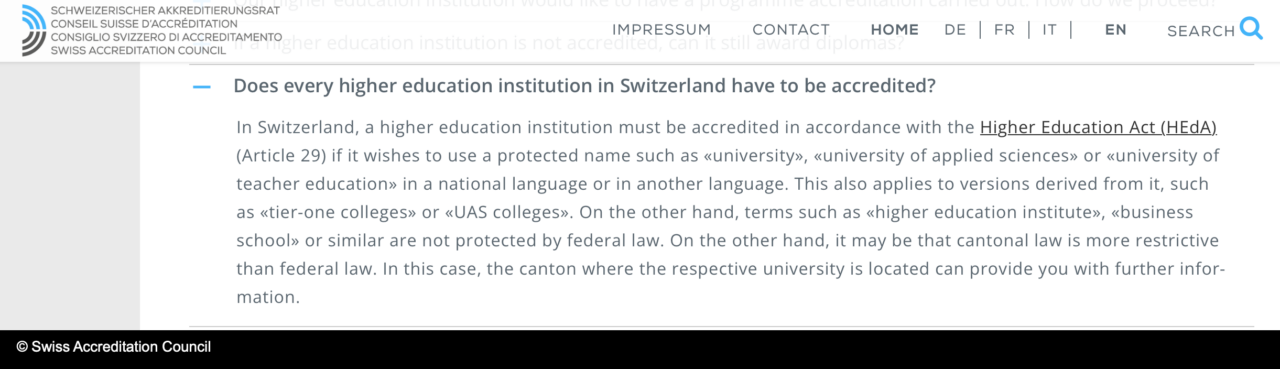
Why are not all higher education institutions in Switzerland accredited?

Private higher education institutions that do not wish to make use of the right to use reserved designations under Article 29 of the Higher Education Act (HEdA) do not have to be accredited. However, according to Article 2 HEdA, all public higher education institutions – i.e., federal and cantonal higher education institutions – must be accredited.

Source: Swiss Accreditation Council; extracted from the FAQ section, from the question, “Why are not all higher education institutions in Switzerland accredited?” Read more here.
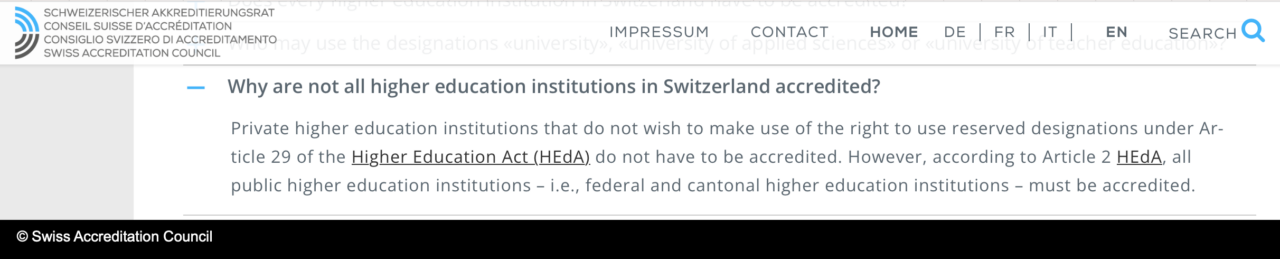
Does the accreditation of a higher education institution also mean that its study programmes are accredited?

In Switzerland, the accreditation of study programmes is not mandatory. Within the framework of institutional accreditation, higher education institutions prove that their quality assurance system covers all areas, and thus also the study programmes. However, they are thereby not formally accredited as programmes.

Source: Swiss Accreditation Council; extracted from the FAQ section, from the question, “Does the accreditation of a higher education institution also mean that its study programmes are accredited?” Read more here.
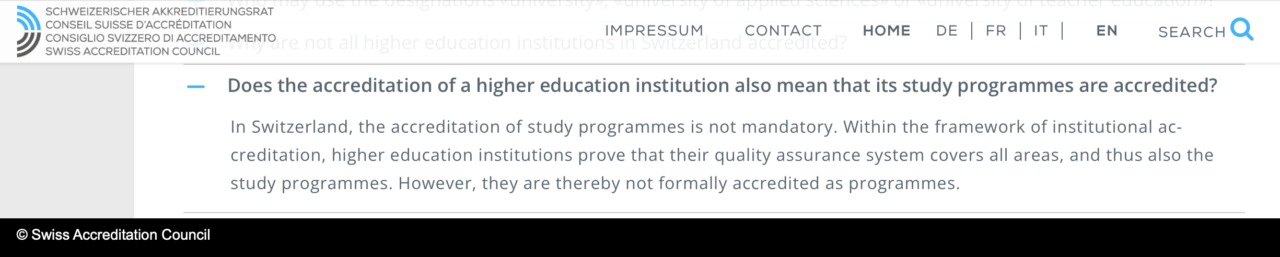
Are the accreditation conditions the same for private and public higher education institutions?

First of all, it should be emphasised that at the level of Federal Legislation, not all private higher education institutions are obliged to be accredited under the Higher Education Act (HEdA), but only those that wish to use a designation protected by the HEdA (Article 29) such as «university», «university of applied sciences» or «university of teacher education». The Cantons, which also have competences in this area, may, however, enact stricter legislation than that existing at federal level.

The HEdA Accreditation Ordinance does not distinguish between private and public higher education institutions. Article 4 paragraph 1 of the HEdA Accreditation Ordinance defines the requirements for admission to the accreditation procedure. Once a higher education institution has been admitted to the accreditation procedure, the standards of the HEdA apply to the accreditation of the higher education institution (HEdA Accreditation Ordinance Article 22 Paragraph 1). The accreditation guidelines enact a uniform set of standards that apply equally to public and private higher education institutions.

Source: Swiss Accreditation Council; extracted from the FAQ section, from the question, “Are the accreditation conditions the same for private and public higher education institutions?” Read more here.
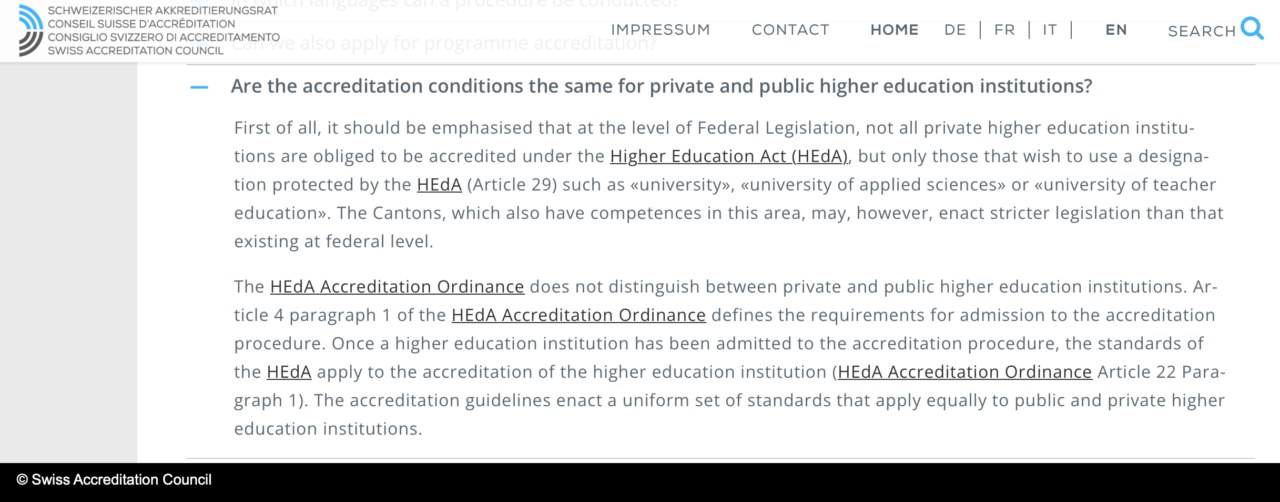
Quality accreditation is not mandatory and does not apply to SIMI Swiss, so why does SIMI Swiss still pursue accreditation?

Although quality accreditation is not mandatory and does not apply in the case of SIMI Swiss, SIMI Swiss does not view accreditation as a marketing or image-building activity. Instead, SIMI Swiss sees accreditation as an opportunity for continuous quality improvement, helping students gain access to a world-class program.

View all of SIMI Swiss’s accreditations here.

FAQs for Recognition

What is the difference between accreditation and recognition?

The difference between accreditation and recognition lies in their purpose and function in the context of education:

Accreditation:
  1. Definition:
    Accreditation is a formal process where an independent authority evaluates and certifies that an institution or program meets specific quality standards. It ensures the institution provides education at an acceptable level of quality.
  2. Focus:
    Primarily focuses on quality assurance and adherence to established educational standards.
  3. Authority:
    Conducted by authorized accrediting agencies, often independent or government-approved, such as AACSB for business schools or regional accreditation bodies in the U.S.
  4. Scope:
    Applies to institutions or programs and verifies their legitimacy and standardization.
  5. Impact:
    Accreditation assures stakeholders (students, employers, etc.) that the institution or program meets high educational standards and allows access to financial aid, credit transfers, or further studies.
Recognition:
  1. Definition:
    Recognition refers to the acceptance or acknowledgment of an institution, program, or qualification by third parties, often for professional purposes. This is not always automatic and varies by country and field.
  2. Focus:
    Primarily focuses on acceptance of the qualification for further studies, employment, or other purposes.
  3. Authority:
    Determined by third parties and end users.
  4. Scope:
    Recognition does not necessarily evaluate quality but confirms that a degree or qualification is accepted within a specific industry.
  5. Impact:
    Recognition determines whether qualifications are valid for purposes like employment, licensing, or further education in a specific region or field.

In the context of private higher education, the recognition of qualifications from a Private Higher Education Institute is determined by the end user, as it is rooted in academic freedom and the autonomy of educational higher education institutions.

Summary of the Difference:
  • Accreditation ensures the quality and legitimacy of the educational offering.
  • Recognition determines whether the accredited qualification is accepted in a particular context or by a particular organization or government.
Example:
  • In the context of SIMI Swiss, higher education institutions are not mandatory to obtain accreditation in Switzerland after receiving a license but might seek recognition from a professional organization (for example OTHM, ATHE, Qualfi) in another country for their graduates to practice in that field.
  • Although not mandatory, to ensure quality, continuous improvement opportunities, and broader recognition in the workplace, the Swiss Information and Management Institute (SIMI Swiss) has achieved accreditation at both the institutional and program levels. The programs of SIMI Swiss are mapped and recognized by Ofqual UK.Gov Awarding Bodies, thereby maximizing the potential for qualifications from SIMI Swiss to be widely recognized in the workplace across most countries and territories. Read more [HERE]

Is recognition automatic?

No, recognition is not automatic. It often depends on specific factors and may require additional processes to ensure a qualification or institution is recognized in a particular country, organization, or industry. Below are key points to understand about recognition:

Factors Affecting Recognition:
  1. Accrediting Body:

    • If a program or institution is accredited by a globally or regionally reputable body, it has a higher chance of being recognized.
    • For example, qualifications aligned with frameworks like Ofqual (UK) or accredited by internationally respected bodies are more likely to be recognized.
  2. Jurisdictional Policies:

    • Each country or organization has its own policies for recognizing foreign qualifications. Recognition often requires alignment with local standards.
  3. Professional or Regulatory Requirements:

    • Some fields (e.g., medicine, law, engineering) require qualifications to meet professional licensing standards, which might involve additional verification, exams, or certifications.
  4. Mutual Recognition Agreements (MRAs):

    • Some countries have agreements to recognize each other's qualifications, which can simplify the process.
  5. Process of Recognition:

    • In many cases, individuals or institutions must apply for recognition by submitting documentation, such as transcripts, accreditation proof, or program mapping.
Key Takeaway:

Recognition is not automatic and often involves ensuring alignment with local, national, or professional standards. Accredited programs or qualifications mapped to international frameworks, like those of Ofqual UK, can streamline recognition processes but do not guarantee automatic acceptance.

Understanding this and recognizing that it is beyond the authority of SIMI Swiss, SIMI Swiss does not commit to this, as stated in all its documents and communicated to students, partners, and third parties

How can I verify if a diploma from SIMI Swiss is mapped to an Ofqual UK.Gov Awarding Body?

The Swiss Information and Management Institute (SIMI Swiss) have aligned their programs with UK awarding bodies regulated by Ofqual, such as OTHM and QUALIFI. This alignment allows students to receive dual qualifications: one from the Swiss institution and an additional diploma from the UK awarding body. According to Swiss law, a Private Degree, such as that of SIMI Swiss, can be used in the workplace, and its recognition is determined by the employer. Therefore, with the integration of Ofqual UK.Gov Awarding Body, the opportunities for dual-degree utilization are significantly expanded.

To verify SIMI Swiss's recognition by Ofqual UK.Gov Awarding Bodies (such as OTHM and Qualifi), you can check SIMI Swiss's accreditation status on the official portals of OTHM and Qualifi or review the proof of recognition provided by these bodies.

To verify the recognition of Ofqual UK.Gov Awarding Bodies, you can check the UK government's official portal. Since these qualifications are mapped to the Regulated Qualifications Framework (RQF), they are officially recognized within the UK and can enhance broader international recognition.

However, recognition of qualifications can vary by country and industry. It's advisable to consult with local professional bodies or employers in your target region to confirm acceptance.

In summary, while the mapping of SIMI Swiss and PIS programs with Ofqual-regulated awarding bodies enhances their recognition potential, it's important to verify acceptance with relevant authorities or organizations in the specific country or industry where you intend to use the qualification before enrollment.

How can one identify and distinguish between regulated and non-regulated professions in Switzerland?

In Switzerland, professions can be broadly categorized into regulated and non-regulated professions. Understanding the difference between these two categories is crucial for both Swiss citizens and international professionals aiming to work in Switzerland.

Regulated Professions:

Definition:
  • Regulated professions are those that require specific qualifications and certifications by law to practice. These professions are often subject to oversight by professional bodies or government agencies.
Examples:
  • Healthcare: Doctors, nurses, pharmacists, and other healthcare professionals must meet stringent educational and certification requirements.
  • Law: Lawyers and notaries must be admitted to the bar and fulfill specific educational criteria.
  • Engineering and Architecture: Certain engineering disciplines and architecture require accreditation from recognized professional bodies.
  • Finance: Some financial roles, such as auditors and accountants, may require certification from recognized institutions.
Requirements:
  • Qualifications: Specific academic degrees, professional training, and sometimes additional exams.
  • Certification: Registration with a professional body and compliance with ongoing professional development requirements.
  • Licensing: Official licenses to practice, often requiring renewal.

Non-Regulated Professions:

Definition:
  • Non-regulated professions do not have legal restrictions on who can practice. While qualifications can enhance employability, they are not legally mandated.
Examples:
  • Managers: Managers play a crucial role in the success and efficiency of organizations like CEO, HRM…
  • Journalists: Their roles are multifaceted and encompass various responsibilities that ensure the delivery of accurate, unbiased, and timely information
  • Information Technology: Roles such as software developers, IT consultants, and network administrators.
  • Marketing and Sales: Marketing specialists, sales representatives, and business development professionals.
  • Creative Industries: Graphic designers, artists, writers, and media professionals.
  • Hospitality and Tourism: Hotel management, tour operators, and restaurant management.
Requirements:
  • Qualifications: While not legally required, relevant academic degrees and professional certifications can improve job prospects.
  • Experience: Practical experience and a proven track record are often highly valued.
  • Skills: Specific skills and competencies relevant to the industry.

Key Differences:

Legal Requirements:

  • Regulated: Legally mandated qualifications and certifications.
  • Non-regulated: No legal restrictions, though qualifications can enhance employability.

Oversight:

  • Regulated: Subject to oversight by professional bodies and government agencies.
  • Non-regulated: No formal oversight, though industry standards and employer preferences apply.

Mobility and Recognition:

  • Regulated: International qualifications may require recognition and equivalence assessments.
  • Non-regulated: More flexibility, with qualifications and experience often being transferable.

Programs at SIMI Swiss lead to non-regulated professions:

  • As a private higher institute in Zug, Switzerland, SIMI Swiss offers single-degree programs (degrees awarded only by SIMI) in the field of non-regulated professions.
  • These non-regulated profession programs enable graduates to work in fields such as management, CEO, human resources director, and principal (director of an educational institution).

Programs of SIMI Swiss lead to regulated professions:

SIMI Swiss only offers programs leading to regulated professions in collaboration with another university.

Through the dual degree system and mutual recognition of results from partner universities, students receive dual degrees. With the second degree from the partner university, students can expand their eligibility for regulated professional fields (if required).

References:

How can one verify whether a profession requires additional licenses or certifications before being practiced in Switzerland?

To verify whether a profession requires additional licenses or certifications before being practiced in Switzerland, follow these steps:

  1. Check the Federal Authorities:
    • Visit the website of the State Secretariat for Education, Research, and Innovation (SERI), which provides information about the recognition of foreign qualifications and regulated professions in Switzerland.
    • Website: SERI Official Site
  2. Determine if the Profession is Regulated:
    • Regulated professions require specific qualifications or licenses to practice, such as in healthcare, law, teaching, or engineering.
    • Non-regulated professions may not require formal recognition but might have industry-specific standards.
  3. Consult the Professional Registry:
    • Some professions have dedicated regulatory bodies or registries in Switzerland. For example:
      • Doctors: Swiss Medical Association (FMH)
      • Architects: REG A and REG B registries
      • Teachers: Swiss Conference of Cantonal Ministers of Education (EDK)
  4. Contact Cantonal Authorities:
    • Requirements can vary by canton in Switzerland. Contact the relevant cantonal office to confirm any additional requirements for your profession.
  5. Review International Qualification Recognition:
    • If you hold foreign qualifications, check their eligibility for recognition in Switzerland. SERI provides detailed guidance on recognition processes and necessary steps.
  6. Seek Professional Advice:
    • For complex cases, you may consult a lawyer or career advisor specializing in Swiss labor laws and professional licensing.

Check out this video to help you understand which majors and fields require additional licenses to work in Switzerland [HERE].

Why do SIMI Swiss implement a Dual Qualification system?

SIMI Swiss is not a local higher education institution but an international one, and with its Swiss Truly International™ positioning, every program is designed for global students with the mission of offering more than one opportunity in the international job market.


For this reason, SIMI Swiss integrates programs and qualifications recognized by the UK Government, ensuring maximum benefit for learners.


This is not merely a dual-degree model, but a system that optimizes both recognition and competency: (1) a UK Government-recognized qualification that evidences professional ability, and (2) a Swiss private degree that reflects the prestige of Swiss education.


To further enhance employability, SIMI requires graduates to present both qualifications simultaneously, ensuring comprehensive recognition from employers.

SwissUK Higher Education Institute